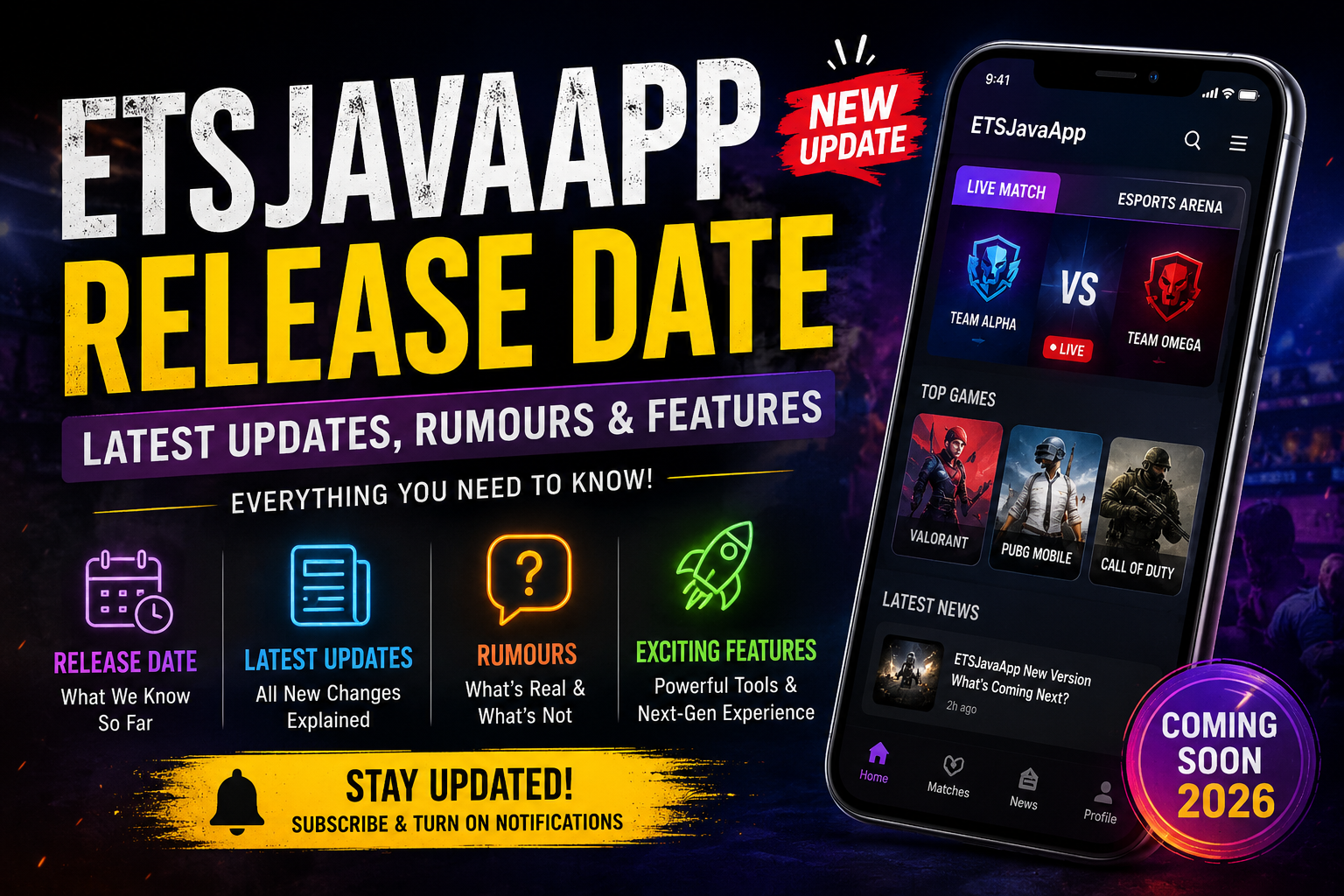
The search phrase etsjavaapp release date has become one of those niche topics that pulls in a lot of curiosity and a lot of confusion at the same time. Publicly available references do not tell one clean story. Some pages describe ETSJavaApp as a gaming and esports hub, while others frame it as a Java-based platform, and a few even present it as a broader enterprise or workflow tool. That mix is exactly why readers keep searching for a clear release date, only to find inconsistent descriptions and recycled claims instead of one official timeline.
From the material that is available online, ETSJavaApp appears to be a brand that is used in multiple contexts, but the most visible version of the site describes itself as a place for gaming news, development insights, player strategies, and esports highlights. The official-looking site also publishes posts about a “new version,” “release date,” and “update” cycle, which makes the brand feel active even though the public record still looks fragmented. That is why any serious discussion of the etsjavaapp release date has to separate verified facts from speculation.
What Is Actually Confirmed About the ETSJavaApp Release Date?
The most important thing readers need to know is simple: there is no universally confirmed public release date that can be verified from an official announcement in the search results I found. One recent analysis says that many specific dates circulating online, including August 2024, October 2024, and June 18, have appeared in blog posts without being traced back to an official statement. That same source warns that a date without an official citation is speculation, not reporting.
That does not mean there is nothing happening. It means the conversation around the etsjavaapp release date is still driven by partial information, repeated summaries, and SEO-driven content rather than a clean public roadmap. Another source on the official-looking etsjavaapp.com site includes posts titled “Release Date Etsjavaapp,” “New Version Etsjavaapp,” and “Etsjavaapp New Version Update From Etruesports,” which strongly suggests that the topic is being actively promoted online. Even so, promotion is not the same thing as formal product disclosure.
Because of that, the safest way to write about the etsjavaapp release date is to say that the public timeline remains unclear, while the online conversation suggests ongoing development and version updates. A site page linked to the author Fendric Zolmuth says the project has been “rebuilt” over the past six months, and another post says readers are tired of vague “coming soon” updates. Those lines do not give a final launch date, but they do show that people behind the content are trying to position the project as still evolving.
Why the ETSJavaApp Release Date Is So Hard to Pin Down
The reason the etsjavaapp release date creates so much search demand is that the public information landscape is messy. One article specifically says the confusion comes from inconsistent descriptions of the software across different sites, with some calling it a logistics platform, others a Java development tool, and others an esports application. When a product is described in three different ways, readers naturally assume they are missing a hidden announcement, and that keeps the search volume alive.
That same article also argues that the confusion likely comes from recycled SEO content, where websites echo each other instead of checking an original source. In practical terms, that means the more people search for the etsjavaapp release date, the more unrelated pages appear, and the more the same claims get repeated without verification. This is one reason the topic can feel more “active” than it really is. Search visibility can make a subject look official long before there is a clear public release note.
A second reason the topic is confusing is that the official-looking site itself speaks in broad branding language rather than concrete product-release language. The homepage frames ETS Java App as a gaming-focused hub, and the author archive shows posts that sound like launch teasers, update notes, and version commentary. That creates momentum, but it does not solve the biggest question readers have: when is the real release date, and what exactly is being released?
Latest Updates Around ETSJavaApp
The latest updates connected to ETSJavaApp are not cleanly packaged as a formal press release, but the site ecosystem does give clues. On the author archive page, the posts “Etsjavaapp New Version,” “New Version Etsjavaapp,” and “Etsjavaapp New Version Update” all suggest an active update cycle, and one line says the project has been rebuilt from the ground up over six months. That kind of language points to ongoing development work, even if the exact public release schedule remains unclear.
One more recent guide claims that the latest ETSJavaApp version launched in February 2025 as version 4.0. According to that write-up, the update was not just cosmetic; it supposedly brought a backend overhaul, stronger security, improved compatibility, and faster performance. Because that claim comes from a third-party article rather than a clearly verifiable product announcement, it should be treated as reported information, not ironclad proof. Still, it is one of the clearest timeline claims currently visible online.
That same source also presents a version history that stretches from an estimated v1.0 around 2019 through esports expansion, stability fixes, UI redesigns, and a 2025 v4.0 refresh. Again, those details are not the same as a formal changelog from a recognized vendor, but they help explain why readers think ETSJavaApp is still in a development or upgrade cycle. The bigger pattern is that the brand is being discussed as if it is live, evolving, and changing, even though the public evidence is uneven.
A separate analysis takes an even more cautious view and says ETSJavaApp currently lacks several signs you would normally expect from a fully documented software launch, such as clear developer announcements, public documentation, verified download pages, or a GitHub repository. That warning matters because it helps readers understand why the etsjavaapp release date is being debated in the first place. When standard launch signals are missing, rumors grow faster than facts.
Rumours Readers Keep Seeing Online
The rumours surrounding ETSJavaApp tend to fall into two broad categories. The first group is release-timing speculation, where pages hint at “soon,” “expected,” or “coming soon” without proving the date. The second group is feature speculation, where the app is described as if it already has a full roadmap of tools, integrations, and performance upgrades. Both styles are common in SEO-heavy content because they sound informative without forcing the writer to prove much.
Some pages present ETSJavaApp as if it is a sports and esports tracking platform. Others describe it as a Java-based application platform or enterprise-grade tool. That variation is important because it changes the whole meaning of the release-date discussion. A consumer-facing gaming app, a developer tool, and an enterprise workflow platform would not share the same launch expectations, update pace, or feature priorities. The online noise makes it harder for users to know which version of the story they are actually reading.
There is also a credibility issue. One critical source argues that the eTrueSports ecosystem behaves like a content farm, with pages designed to attract traffic through broad keyword coverage and repetitive publishing patterns. That is a strong accusation, and readers should understand it as the opinion of that source rather than a universal fact. Even so, it reinforces an important SEO lesson: whenever a topic is dominated by low-trust pages, the smartest content is usually the content that clearly distinguishes verified information from rumor.
For SEO readers, this means the best article about the etsjavaapp release date should not pretend certainty where none exists. It should acknowledge the speculation, note the conflicting descriptions, and then give the user a practical roadmap for how to monitor updates safely. That approach builds trust, improves dwell time, and reduces the chance of publishing misleading information that could age badly later.
Features Commonly Associated With ETSJavaApp
Even though the exact product story is inconsistent, several feature themes appear again and again across the available pages. The most common one is real-time information delivery. The more optimistic write-ups about ETSJavaApp describe faster score updates, lower latency, and improved performance during live events. Those claims are consistent with the idea of a sports and esports tracking platform, even if they are not confirmed by a major independent product listing.
Another repeated theme is cross-platform compatibility. One guide says the platform supports Windows and macOS, while Linux compatibility is referenced but not clearly confirmed for a public rollout. That is a useful detail because it suggests the product, at least in the way it is being described online, is meant to serve users across multiple environments rather than only mobile fans. If true, that would make the etsjavaapp release date more important for desktop and technical users as well as casual readers.
Security and stability are also mentioned frequently. A 2025 update claim says version 4.0 included a structural overhaul of the backend, security framework, and compatibility layer. The same source says that the update improved authentication, encryption, caching, and crash handling during peak traffic. These are the kinds of features that readers care about because they translate directly into a smoother user experience, whether the platform is used for gaming news, sports data, or esports tracking.
Personalization and interface improvements appear in the version-history narrative too. The write-up that traces ETSJavaApp’s development claims there was a UI redesign in version 3.0 and personalization features later on. That is a familiar pattern in modern apps: first comes stability, then speed, then personalization, then broader ecosystem integration. Readers searching for the etsjavaapp release date are usually looking for more than a launch announcement; they are trying to understand whether the next version will finally feel polished enough to use regularly.
AI analytics is another recurring buzzword in the reporting. One source says version 4.0 included AI analytics, while another implies the app is being positioned as a future-facing platform rather than a static news site. That kind of feature is attractive because it sounds modern, but it also deserves scrutiny. In SEO terms, AI is one of those words that can boost clicks while revealing very little unless the author explains exactly what the feature does.
What the Release Date Could Mean for Different Readers
For casual readers, the etsjavaapp release date matters because they want to know whether the platform is worth their attention now or later. If the project is truly moving toward a stable public release, then the launch timing may determine when people start trusting it for frequent updates, guides, or esports coverage. If it remains mostly a rumor-driven topic, then readers should treat it as a watchlist item rather than an essential download.
For developers, the release date matters for a different reason. A public launch normally signals that documentation, compatibility, bug fixes, and version stability are mature enough for real-world use. If the product is still in an uncertain phase, then developers should be careful about depending on it for workflows or integrations. The “verified channels” guidance from the available analysis is useful here because it gives technical users a simple standard: look for official websites, developer announcements, public documentation, and verified download pages before taking a tool seriously.
For SEO publishers, the release date matters because it is a high-interest keyword with commercial search intent. Users who search for a launch date often want immediate clarity, and that means a page can earn clicks if it answers the core question quickly. But searchers also punish empty articles. If your content only repeats rumors, it may get traffic briefly and then lose trust. A strong etsjavaapp release date article should be clear, cautious, and useful enough that readers feel they have learned something real.
For the site owner or brand team, the release date is a chance to build authority. A clean announcement page, a public changelog, a visible support page, and a consistent product description would immediately reduce confusion. That would also make future content easier to rank because search engines could connect one product name to one stable set of facts instead of a trail of contradictory posts. The current online pattern suggests that this kind of clarity would be valuable.
How Readers Should Evaluate ETSJavaApp Updates Safely
The best way to judge ETSJavaApp updates is to look for source quality before trusting the message. A post that gives a specific release date but offers no official citation should be treated as a rumor. A post that talks about a new version but does not show a changelog should be treated as an overview, not a technical reference. And a post that mixes marketing copy with launch language should be read carefully, because the goal may be ranking rather than informing.
Readers should also notice whether a page explains the product clearly. The online record around ETSJavaApp is inconsistent enough that one article had to explicitly say the software is described as different things by different sites. That inconsistency alone is a warning sign. Real products can evolve, of course, but they usually do not require three completely separate explanations of what they are before the audience can even understand the release date discussion.
Another smart habit is checking whether the platform has a stable public footprint. The available analysis says real software launches normally include official websites, developer announcements, public documentation, verified download pages, and GitHub repositories. If a project is missing most of those signals, then the safest assumption is that the launch information is incomplete. That does not mean the product is fake in every case, but it does mean readers should avoid building expectations on vague blog posts alone.
There is also a security angle. One critical article warns that some of the surrounding ecosystem may try to push questionable download paths or misleading links, and it recommends caution. Whether or not a reader accepts that article’s stronger conclusions, the practical advice is still sound: do not install software from an unverified source just because a page mentions a release date. The launch date should never become a shortcut around basic safety checks.
Why This Topic Still Has SEO Potential
The etsjavaapp release date topic still has SEO potential because it taps into three things search engines usually reward: curiosity, timeliness, and ambiguity. People want a date, they want it now, and they are willing to click multiple pages to find it. That creates an opportunity for a well-written article that gives a calm, structured explanation instead of a bait-and-switch headline.
It also has potential because the topic is not yet fully settled. Search demand tends to stay high when users keep returning to the same question and the web keeps giving them slightly different answers. That means a strong page can rank if it satisfies the user better than the thin articles around it. The best angle is not to shout the loudest claim, but to explain the uncertainty more clearly than everyone else.
Another reason the topic can perform well is that readers are not only looking for a date; they are also looking for features, legitimacy, and updates. A page that covers the launch rumor, the latest version talk, the feature expectations, and the credibility concerns in one place will usually feel more complete than a short post that only repeats “coming soon.” That broader coverage is especially useful for Rank Math style optimization because it helps the content answer related search intent in a single page.
Final Thoughts on the ETSJavaApp Release Date
At this point, the smartest summary is that the etsjavaapp release date remains a heavily searched but still not fully verified topic. Some sources portray ETSJavaApp as a gaming and esports brand, some frame it as a Java platform, and some describe a more enterprise-style software vision. Meanwhile, the most cautious analyses say that specific dates online have not been officially confirmed and that the public evidence is still inconsistent.
What does seem clear is that the name continues to be used in connection with updates, version talk, and launch speculation. The official-looking site includes posts about a “new version” and a “release date,” while one guide claims a February 2025 version 4.0 update with performance, security, and compatibility improvements. Those details are useful, but they should still be read as part of an evolving public story rather than the final word.
If you are writing for readers who want trust, the right editorial move is to stay precise. Say what is confirmed. Say what is rumored. Say what is missing. Then tell the audience exactly where to watch next: official announcements, public documentation, verified downloads, and clearly published version notes. That approach does more than protect credibility. It also makes the article more useful, more search-friendly, and more likely to keep readers on the page.
For anyone tracking the topic closely, the safest action is to follow only the most transparent sources and avoid treating speculative posts as launch news. Until a clearly verified announcement appears, the etsjavaapp release date should be treated as an active rumor cycle with some update signals, not a fully settled product launch. That is the honest answer, and in SEO, honesty is often what helps a page last.



Post Comment