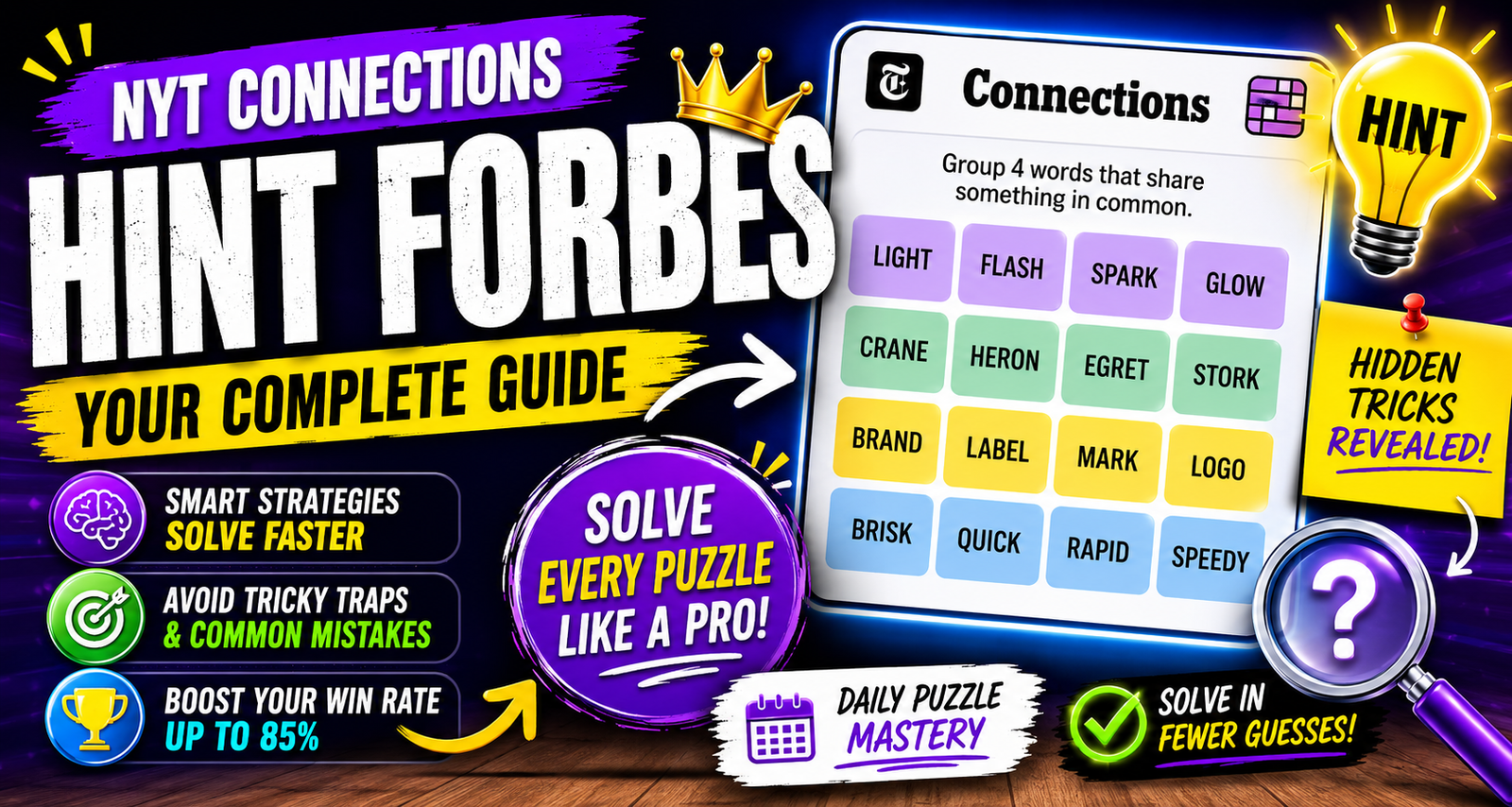
If you have ever stared at a grid of 16 words and felt your brain freeze for a second, you are not alone. The New York Times Connections puzzle looks simple at first glance, but that is exactly what makes it so tricky. One moment you think you have a perfect group of four, and the next moment the game throws a curveball that turns your confident guess into a wrong answer. That tension is part of what makes Connections so addictive, and it is also why so many players search for reliable guidance like nyt connections hint forbes when they want a smarter way to play.
This guide is designed to help you understand the puzzle more deeply, improve your solving strategy, and learn how to think like a sharper Connections player. Whether you are a beginner who just wants to avoid losing streaks or a daily player chasing faster solves and fewer mistakes, this article will walk you through the logic, the patterns, and the mindset that make the game much easier. You will also find practical advice on how to use hints without ruining the fun, how to spot category traps, and how to build the habits that turn frustration into confidence.
nyt connections hint forbes: Smart Strategies That Make Every Puzzle Easier
The phrase nyt connections hint forbes has become popular because many players want a simple, trustworthy way to improve their game without spoiling the challenge. The best hint is not just a random nudge toward one category. The best hint teaches you how to think. Once you understand the puzzle’s structure, you stop relying on luck and start recognizing patterns faster. That is where real progress happens.
Connections is built around grouping four words that share a hidden link. The categories may be easy, medium, or deceptively difficult. Some are straightforward, such as colors, animals, or common phrases. Others are clever and require you to notice wordplay, multiple meanings, pop culture references, abbreviations, or even language tricks. A strong player does not simply look for matching words. A strong player looks for relationships, categories, and the most likely trap hidden inside the grid.
One of the biggest reasons people search for Connections hints is that the puzzle rewards careful observation more than rushed guessing. It is easy to get fooled by words that seem related but actually belong to different groups. For example, four words may all feel connected because they share a theme, but only one exact grouping is correct. That is why a methodical approach matters more than a random one. The game is not trying to test only your vocabulary. It is testing your flexibility, your attention to detail, and your ability to shift mental frameworks quickly.
Why NYT Connections Feels Easy Until It Suddenly Does Not
At its core, Connections is elegant. You see 16 words, and your job is to sort them into four sets of four. The elegance is part of the trap. Because the interface is so clean, many players assume the solution should be obvious. But the puzzle is intentionally designed to make obvious ideas compete with less obvious ones. It thrives on ambiguity.
A common mistake is to focus on the first connection that comes to mind and then force the remaining words to fit. This often leads to wasted guesses. The puzzle punishes overconfidence. Sometimes a group looks easy because all four words can belong to a broad theme, but the real category is something narrower and more specific. Other times a word appears to belong in one group when it was actually placed there as a decoy.
Another challenge is that one word can suggest multiple meanings. A word might be a noun in one context and a verb in another. It might appear to belong to a common category but instead be part of a phrase, a brand, a title, or a metaphorical set. The puzzle often uses this kind of misdirection to make players hesitate. That is why a successful approach depends on knowing how Connections creators think. They love clean logic, but they also love clever twists.
The good news is that once you learn the puzzle’s style, the game becomes less mysterious. You begin to recognize recurring patterns. You notice that some categories are built around synonyms, while others depend on word fragments, starts and ends of phrases, or hidden cultural references. This awareness alone can improve your success rate dramatically.
The Best Way to Start Any Connections Puzzle
When you open a new puzzle, the first instinct is usually to scan for familiar words and guess the easiest category. That is a decent instinct, but there is a better way to begin. Instead of asking, “Which four words obviously belong together?” ask, “What are the possible ways these words could be grouped?” That slight shift changes everything.
Start by reading every word once without committing to a guess. Let the whole board settle in your mind. Then look for repeated themes. Ask yourself whether any words look like synonyms, colors, names, objects, verbs, slang terms, or parts of phrases. Some players do better by saying the words aloud. Others prefer to write possible connections mentally. The method is less important than the discipline of scanning before guessing.
It also helps to identify the safest group first. A safe group is one that seems least likely to be confused with another set. If you can confidently isolate one category early, you reduce the number of possible traps left in the grid. That can make the remaining words easier to interpret because fewer false overlaps remain. In other words, solving one group often reveals the shape of the others.
Do not ignore words that seem too simple. In Connections, simplicity can be deceptive. The easiest-looking word often turns out to be the key to the hardest category. Likewise, a strange or unusual word may be the puzzle’s anchor for a more obvious group. The trick is to avoid tunnel vision. Scan the board as a whole, not word by word in isolation.
How to Spot Hidden Categories Faster
The most successful players train themselves to spot not only what words mean, but how they function. This is where a lot of mistakes happen. A word might look like an object, but it may actually be part of a phrase. Another word might appear to describe an action, but it is really a proper noun. The category is often hiding in the structure rather than the surface meaning.
One practical technique is to test categories in layers. First, check for obvious semantic groups like animals, foods, tools, or emotions. Then move to more abstract relationships such as words that can follow another word, words that share a prefix or suffix, or words that have multiple meanings. Finally, consider cultural or contextual themes, including entertainment, geography, brands, sports, and idioms.
A lot of players lose because they stop at the first layer. They see four words that all seem related and lock them in too quickly. But Connections often rewards a second look. For example, a word that seems to fit a group of “things in a kitchen” might actually belong to a group of “words that can precede the same noun.” That kind of trick is common because it creates an almost-correct answer that feels convincing.
The more you play, the more you notice recurring styles of trickery. One category may rely on homonyms. Another may depend on phrases used in everyday speech. Another may require you to think about a word in a completely different sense. Once your brain expects these tricks, you become far less vulnerable to them.
The Psychology Behind Solving Connections Well
There is a mental side to Connections that many people overlook. The puzzle is not just a vocabulary challenge. It is a test of patience, pattern recognition, and emotional control. When players get stuck, they often begin to guess impulsively. That usually makes things worse. The moment frustration enters the game, the mind narrows. Narrow thinking is the enemy of good puzzle-solving.
A better approach is to stay loose. Treat each board as a set of possibilities, not a set of fixed truths. Your first idea does not have to be your final one. In fact, one of the most important habits in Connections is being willing to abandon a nearly-right answer when the board says no. Strong solvers do not cling to guesses. They revise them.
Another helpful mindset is curiosity. Instead of asking whether your guess is good enough, ask why the puzzle might be trying to mislead you. That small shift turns confusion into investigation. You stop fighting the puzzle and start analyzing it. That makes the game more enjoyable and more effective at the same time.
There is also satisfaction in learning from mistakes. Every wrong guess teaches you something about how the puzzle is constructed. Maybe a word means something unexpected. Maybe the board used a classic decoy. Maybe the category was more specific than you thought. Over time, those lessons compound. Even when you miss a puzzle, you get better at the next one.
Common Connections Trap Types You Should Watch For
Certain traps appear so often in Connections that experienced players begin to recognize them immediately. One of the most common is the “almost-category.” This is when four words seem related, but only three truly belong. The fourth is there to distract you. Another trap is the “double meaning trap,” where a word belongs to one category in your mind but is actually used in a different sense by the puzzle.
A particularly frustrating trap is the phrase-based category. This happens when the words are not linked by their meanings alone, but by the phrases they can create with another word. For example, a set might consist of words that all pair naturally with the same following noun, or words that all complete a familiar expression. These categories are tricky because the connection is invisible until you think in phrases instead of standalone words.
There is also the pop culture trap. Some boards include references to entertainment, music, television, sports, or famous names. These can be easy if you know the reference, but tough if you do not. The challenge is that pop culture clues often compete with ordinary word meanings. A word may seem like a basic noun when it is actually a reference to a character, title, or brand.
Another tricky pattern is the letter or sound-based category. These can involve words that begin or end the same way, words with a shared root, or words that fit a structural rule. Because the connection is not purely semantic, many players miss it at first. This is why broad thinking matters. The puzzle can ask you to think like a linguist one day and a trivia fan the next.
How to Use Hints Without Spoiling the Fun
Hints are most useful when they guide your thinking instead of giving away the answer too directly. The best hint should help you reframe the board. It should not remove the satisfaction of solving. That balance is what makes hint-based play so valuable. You still get the challenge, but with fewer dead ends and less frustration.
A good hint strategy is to use a light nudge rather than a full solution. For example, instead of looking for the exact answer, focus on the type of category you may be missing. Ask whether the puzzle is using synonyms, abbreviations, phrases, or a shared theme. This keeps the game engaging while helping you escape a mental block.
Some players prefer to solve most of the puzzle first and only use hints when they are down to their last category or two. That approach works well because it preserves the early challenge while protecting you from the final stubborn stretch. Others use hints right away when a board seems unusually difficult. There is no single correct style. The right method is the one that keeps you playing consistently.
What matters most is that hints should make you smarter, not dependent. A good hint teaches a pattern you can reuse later. A weak hint only points to one answer. That is why educational guidance is more powerful than pure spoiler content. It improves your future performance instead of just ending the current puzzle.
How Forbes-Style Connections Guidance Helps Readers Improve
When readers search for nyt connections hint forbes, they are usually looking for something more useful than a one-line answer. They want guidance that feels polished, accurate, and easy to apply. That is where an article like this becomes valuable. It does not just say what the answer is. It explains how to think about the answer and how to recognize similar puzzles later.
A high-quality Connections guide should do three things well. First, it should reduce frustration by showing that the puzzle has a structure. Second, it should improve skill by teaching solve patterns. Third, it should make the reader feel engaged enough to return tomorrow. That combination of clarity, usefulness, and repeatability is exactly what makes strong SEO content perform well too. Readers stay longer, engage more deeply, and come back for more.
This is also why a well-written Connections article can attract organic search traffic over time. People are not only searching for answers. They are searching for methods, context, and confidence. If your content delivers all three, it serves the user much better than a thin recap or an answer-only page.
Building a Better Daily Connections Routine
Solving better is not just about intelligence. It is about routine. People who play Connections consistently often improve because they develop a rhythm. They begin to notice how the game tends to structure its difficulty. They learn to pause before guessing. They get better at reading the board with a calm eye. Over time, that routine changes results.
One helpful habit is to give yourself a short reset after every incorrect guess. Do not immediately fire off another guess in frustration. Take a breath, look at the board again, and ask what you may have missed. This tiny pause can prevent a chain of mistakes. It also helps your brain stay flexible, which is crucial when the categories are subtle.
Another useful habit is to think in terms of elimination. Once you identify one possible group, ask which other words are now less likely to fit together. Elimination helps reduce mental clutter. It narrows the field and makes the remaining patterns easier to see. Many difficult puzzles become manageable once you stop chasing every possible clue at once.
It also helps to revisit old puzzles or reflect on past mistakes. If you remember categories that fooled you before, you become less likely to fall for them again. That kind of self-review is one of the fastest ways to improve. It transforms the game from a daily challenge into a long-term skill.
Why the Game Is So Addictive
Connections works because it blends simplicity and surprise. The format is easy to understand, but the solve is rarely routine. Every puzzle feels like a tiny mystery. You are constantly testing hypotheses, adjusting your thinking, and looking for the hidden rule that makes the board click. That process is deeply satisfying.
The social side also adds to the appeal. Many people enjoy comparing results, discussing tricky categories, or sharing how many guesses they needed. It becomes more than a game. It becomes a daily ritual, a mental warm-up, and a conversation starter. Part of the fun is realizing that other people got stuck on the same category you did.
There is also a strong sense of progress. Even when the puzzle is hard, you can feel yourself becoming better over time. That is motivating. The game gives you frequent feedback, and each successful solve reinforces the idea that you are learning something real. That is one of the main reasons it has become so popular.
The Smartest Mindset for Long-Term Success
If there is one lesson that matters most in Connections, it is this: stay flexible. The puzzle is built to reward players who can shift quickly from one idea to another. A great solve often comes from the moment you stop insisting on the first interpretation and start considering a broader one. Flexibility beats stubbornness every time.
It also helps to respect the board’s design. The puzzle is not random. It is crafted with intention. That means there is always a logic behind the trap, even if you do not see it right away. The more you trust that structure, the less likely you are to panic. You begin to understand that every confusing puzzle still has a clean solution waiting underneath.
Over time, this mindset can improve more than your game. It can sharpen the way you approach problems in general. You learn to step back, look for patterns, and revise your assumptions when needed. That is a valuable skill in everyday life, not just in word puzzles.
Final Thoughts on Solving NYT Connections Like a Pro
The appeal of Connections is that it is quick to play but surprisingly deep to master. A single grid can challenge your vocabulary, your logic, your patience, and your intuition all at once. That is why so many people look for dependable guidance, and why nyt connections hint forbes has become a useful search phrase for players who want both help and insight.
The best way to improve is not to memorize answers. It is to learn how the puzzle thinks. When you understand common traps, phrase-based categories, structural patterns, and the importance of flexible thinking, every board becomes more manageable. You stop guessing blindly and start solving with purpose.
If this guide helped you, bookmark it and return whenever a tough puzzle appears. Share it with friends who love Connections, and use it as a daily reference when you want a smarter solve and fewer wasted guesses. The more you practice these strategies, the more natural they become. And the more natural they become, the more enjoyable the game gets.
For readers who want to keep improving, the next step is simple: play carefully, think broadly, and never let one wrong guess control the rest of the board. Every puzzle is a new chance to sharpen your instincts, build confidence, and enjoy the thrill of finding the hidden connection before anyone else does.

Post Comment