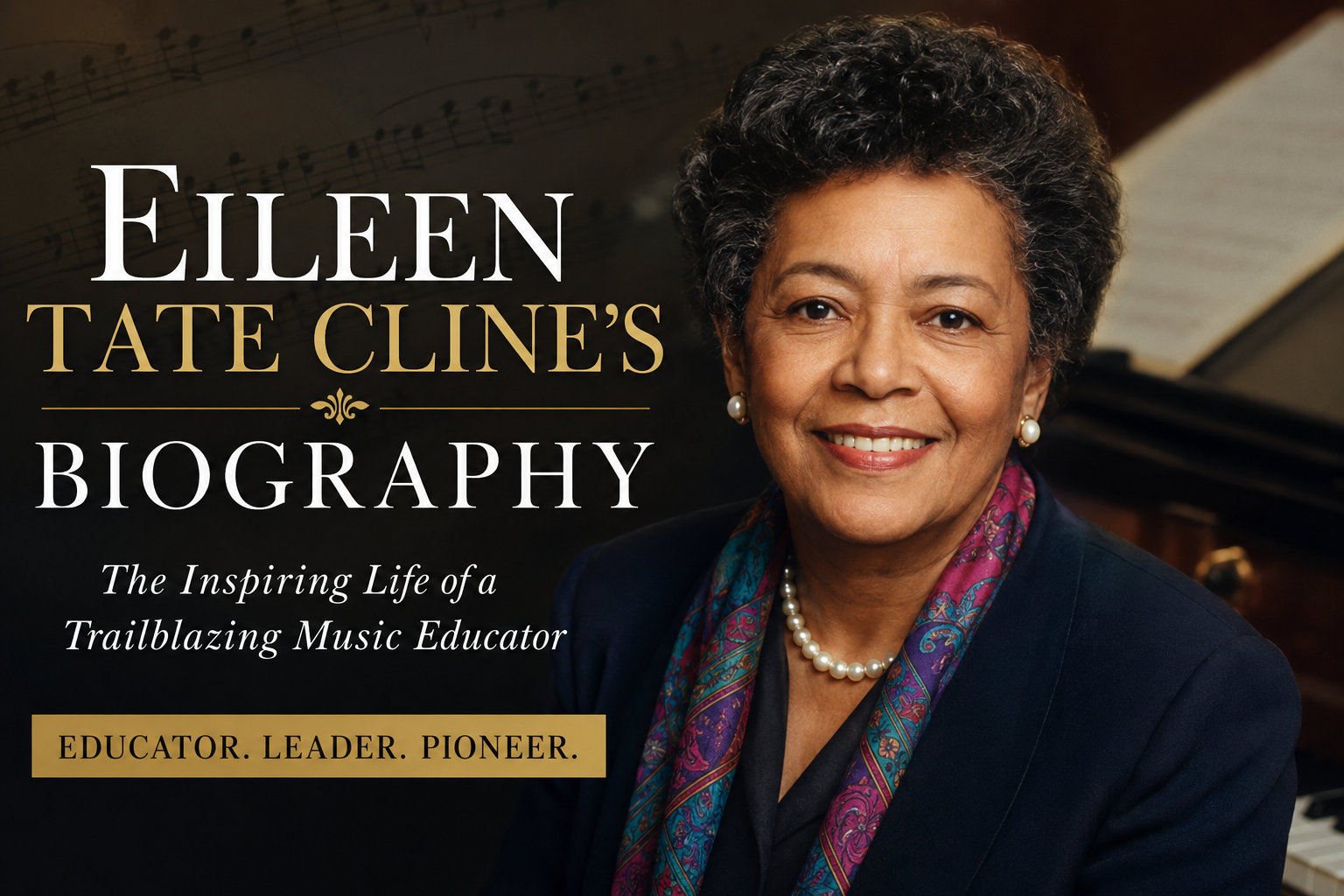
Eileen Tate: The Inspiring Biography of a Music Educator Who Broke Barriers
Eileen Tate Cline’s biography is the story of a woman who turned talent, education, and purpose into a lifelong mission. Born in Chicago on June 25, 1935, Eileen Tate grew up in a family where learning mattered deeply and where music was never treated as a pastime alone, but as a force that could shape character, open minds, and improve communities.
Public records and obituary notices show that she lived a life centered on teaching, leadership, and the arts, and that her influence stretched far beyond one school, one city, or one generation. She passed away on November 17, 2023, at the age of 88, leaving behind a legacy that still speaks to students, musicians, educators, and families who believe the arts should be available to everyone.
What makes the life of Eileen Tate Cline especially compelling is the way she combined excellence with service. She was not simply a performer or administrator. She was an accomplished pianist, folk dancer, and singer who also taught music at the elementary, high school, and university levels, founded the Boulder Children’s Choir, owned a piano studio, and served as executive director of the Neighborhood Music School in New Haven, Connecticut. Later, she became the first Black dean of the Peabody Conservatory in 1983 and, at that time, the only woman dean of a major American conservatory of music. Her biography is important because it shows how quiet dedication can reshape institutions and widen opportunity for others.
Eileen Tate Cline was born into a family that clearly valued education, civic responsibility, and cultural growth. According to The HistoryMakers, her mother, Inez Duke, was a dedicated elementary school teacher and among the first educators to teach Negro History, while her father, Herman Tate, was a community leader who worked for the U.S. Postal Service and participated in the international Coop Movement.
That background helps explain why Eileen Tate Cline saw the arts as part of a broader social mission rather than as something reserved for a privileged few. The foundation of her life was not built on fame or spectacle. It was built on discipline, family values, and a belief that knowledge should be shared in ways that strengthen entire communities.
Her early education also reflected a strong academic path. The obituary notice published after her death states that she began at Shoop Elementary and continued at the University of Chicago Laboratory School. She later studied at the University of Chicago, Oberlin College, and Indiana University. Those institutions are important not just as names on a résumé, but as signs of the depth and seriousness of her preparation.
Eileen Tate Cline was clearly shaped by environments that encouraged high standards and broad artistic thinking. When someone later asks how she developed the confidence to become a conservatory dean and music advocate, the answer is already visible in the seriousness of her educational journey and the family culture that valued learning at every stage.
The most remarkable part of Eileen Tate Cline’s biography is how naturally she connected training with service. She did not treat music as a private achievement to be guarded. Instead, she used music as a practical tool for teaching, mentorship, and access. Johns Hopkins’ Black Faculty and Staff Association described her as an accomplished pianist, folk dancer, and singer who dedicated her career to expanding arts opportunities for others.
That phrase captures the spirit of her life. Whether she was teaching young children, guiding advanced students, or shaping policy in higher education, she worked with the belief that the arts are integral to humanity. Her own words, preserved by Johns Hopkins and her obituary notice, reveal a woman deeply committed to removing the idea that artistic expression belongs only to a “chosen” few.
As a teacher, Eileen Tate Cline made her mark in more than one educational setting. Public sources show that she taught music at the elementary, high school, and university levels, which means she understood music education from the earliest stages of learning to the demands of advanced study. She also owned a piano studio, served as a church organist, and directed the Boulder Children’s Choir.
That combination of roles suggests a professional life built on both artistry and consistency. She was the kind of educator who could meet students where they were, whether they were beginning to read music, discovering the joy of singing together, or developing the discipline needed for serious performance. Her career shows that teaching music is not limited to technique; it is also about confidence, imagination, and helping students find their own voice.
One of the defining achievements in Eileen Tate Cline’s career came in 1983, when she became the first Black person appointed dean of the Peabody Conservatory of Music at Johns Hopkins University. She was also the only woman dean of a major American conservatory of music at that time. That matters because it places her within the history of institutional change, not just individual success.
In leadership roles, she represented both excellence and possibility. The Johns Hopkins tribute notes that her dedication to inclusiveness enriched and expanded the Peabody community, which shows that her leadership was not symbolic. It had real impact on the culture and direction of the institution. For students and faculty who came after her, her presence helped prove that excellence and representation belong together.
Her years as dean were not only about administration; they were about vision. The Peabody Conservatory role placed her in a position to influence how music education could be organized, supported, and opened to a wider range of students. Johns Hopkins noted that after her deanship ended in 1995, she continued to serve for four more years as a senior university fellow in arts policy at the Institute for Policy Studies.
She also contributed through board service with the National Endowment for the Arts and the American Symphony Orchestra League. This tells us that Eileen Tate Cline’s influence did not stop when she stepped away from one office. She remained active in shaping the future of music and the arts, especially in spaces where policy decisions affect access, funding, and educational priorities.
The way Eileen Tate Cline spoke about the arts also reveals a great deal about her values. In the Johns Hopkins tribute, she is remembered saying that many children think the arts are only for people who can draw or sing at a level possible only for a select few, and that she wanted to help “slay those dragons.” That idea is powerful because it captures her lifelong mission in plain language.
She understood the damage that limited thinking can do when children are told, directly or indirectly, that art is not for them. Her response was not to argue abstractly, but to create institutions, choirs, studios, lessons, and leadership spaces where children and adults could experience the arts as accessible, meaningful, and deeply human. That is one of the strongest reasons her biography deserves attention today.
Another important part of Eileen Tate Cline’s life was her family life in Boulder, Colorado. Her obituary states that she and her husband, Dr. William Cline, a linguist, raised their family there. It also notes that she was survived by her children, Dr. Jonathan Cline and Dr. Joy Cline Phinney, along with grandchildren and her sister, Amy Tate Billingsley.
That gives her biography a more personal dimension. She was not only a public educator and institutional leader; she was also a wife, mother, grandmother, sister, and mentor. The details matter because they remind readers that major professional contributions are often carried by people who also give deeply in private life, balancing family responsibilities with public service and long-term community involvement.
Her connection to Boulder also seems to have been creatively productive. Johns Hopkins and the obituary both identify her as the founder of the Boulder Children’s Choir, an initiative that reflects both her teaching philosophy and her desire to build musical opportunities for the young. Founding a children’s choir is more than organizing performances. It means creating a space where discipline, listening, teamwork, and artistic growth can happen together. Eileen Tate Cline’s biography shows that she understood the value of music as an everyday practice, not only as a polished stage presentation. In that sense, her work in Boulder helps explain why so many of her public roles centered on access, inclusion, and the nurturing of young talent.
Her life also connects to larger questions about representation in classical music and education. Being the first Black dean of the Peabody Conservatory was a landmark achievement, but the meaning of that milestone goes beyond a single first. It reflects the reality that prestigious cultural institutions have historically excluded many voices, and that leadership matters when those barriers begin to change. Eileen Tate Cline’s presence at Peabody demonstrated that Black women could lead at the highest levels of conservatory education. More importantly, she used that position to strengthen inclusiveness rather than merely occupy the title. That combination of breakthrough and service is one reason her story remains relevant to readers who care about equity in the arts.
Her legacy is also preserved through memorial and institutional recognition. The obituary notice published by Greenwood & Myers Mortuary and related memorial pages note that donations in her memory could be made to The Aberdeen Gardens Foundation and The Sphinx Organization. This detail is meaningful because it points to the values she left behind: support for a historic community designed by her grandfather and support for diversity in the arts. Even after her passing, her name remains connected to preservation, representation, and cultural memory. That is the mark of a life that mattered not only to family and friends, but also to causes larger than herself.
Readers looking for the deeper meaning of Eileen Tate Cline’s biography will find that her story is not just about credentials. It is about character. She showed how a person can move through teaching rooms, rehearsal spaces, administrative offices, and community settings without losing sight of why the work matters. She believed that music could help make the world better, and her career gives that belief real substance. From classroom teaching to conservatory leadership, from choir building to policy work, she kept returning to the same idea: the arts should enlarge human possibility. That message remains especially powerful for parents, students, educators, and artists who are searching for examples of leadership grounded in service rather than self-display.
For anyone researching Eileen Tate Cline today, the most useful takeaway is that her biography represents both achievement and purpose. She was born in 1935 in Chicago, educated at respected institutions, shaped by a family devoted to education and community life, and ultimately remembered as a musician, educator, and dean who helped transform opportunities for others.
She died in 2023, but the record of her work remains visible through the institutions she served, the students she mentored, the choir she founded, and the example she set. That is why her story continues to deserve attention. It is a biography built on action, not noise. It is a life that left a lasting mark through patience, excellence, and a deep belief in the power of the arts.
Eileen Tate Cline’s story also offers a lesson for modern readers who want success with meaning. She did not separate excellence from generosity. She did not treat leadership as a prize without responsibility. Instead, she used her gifts to expand access and create spaces where other people could grow. That is a timeless model for educators, musicians, nonprofit leaders, and parents alike. If you are building a site around biographies, arts education, or inspiring women in history, her life provides exactly the kind of credible, search-friendly, emotionally resonant material that readers remember. It is the kind of story that invites reflection, shares well, and naturally builds trust because it is rooted in service and real accomplishment.
In the end, Eileen Tate Cline should be remembered as much more than a name in an obituary. She was a musician who believed in opening doors, a teacher who understood the value of every stage of learning, and a dean who helped reshape the cultural space she entered. Her biography is inspiring because it proves that one life, lived with purpose, can influence institutions, families, and future generations at once. Her legacy is still useful today because it reminds us that the arts are not a luxury for the few. They are a shared human good. And that idea, more than any title or award, may be the most important part of Eileen Tate Cline’s enduring story.



Post Comment