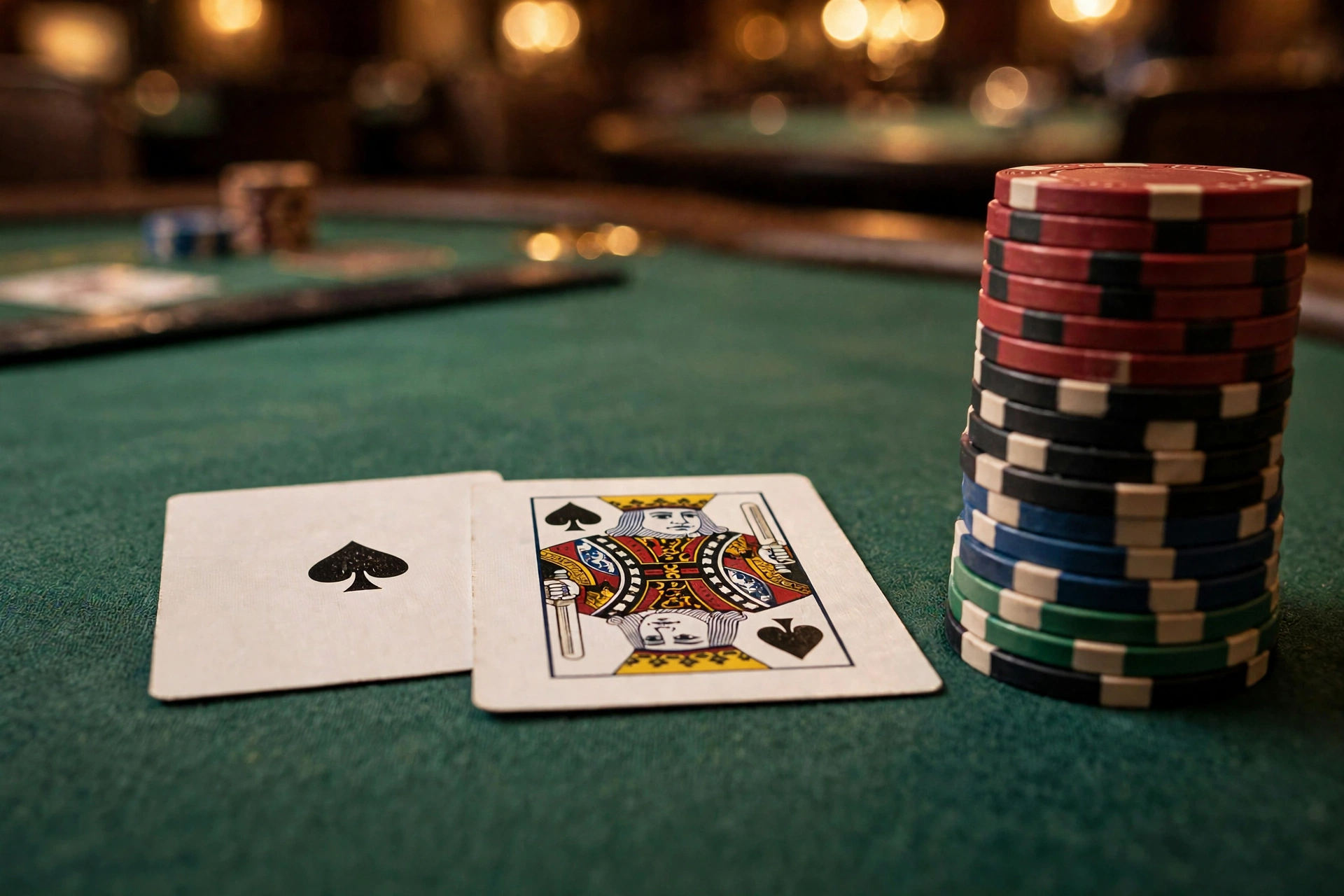
A blackjack “payout” is simply the amount the casino pays you when you win a hand — and the payout that matters most is the one for a natural blackjack. That’s an ace plus any ten-value card (a 10, jack, queen, or king) as your first two cards. When you get one, the table pays you according to the ratio printed on the felt.
The ratio is written as something like 3:2 or 6:5. Read it left to right: the table pays you the first number for every second number you bet. So 3:2 means you win $3 for every $2 you wager — or 1.5 times your stake. A $10 bet returns your $10 back plus $15 in winnings.
Here’s the part beginners get wrong: the payout ratio only applies to a natural blackjack. Regular winning hands — where you beat the dealer with, say, a 19 — just pay 1:1, even money. You bet $10, you get $10. The special payout is reserved for the dream hand, and that’s why the ratio matters so much more than people think.
Once you can read those little numbers, you can instantly judge whether a table deserves your money. That’s really all there is to learning how to read blackjack payouts at the beginner level — but the details below are where your money gets protected.
Table of Contents
What a Natural Blackjack Actually Pays (And Why It’s the Jackpot Hand)
A natural blackjack shows up roughly once every 21 hands — about 4.75% of the time in a standard multi-deck game. It’s the best hand you can be dealt, and casinos reward it with a bonus payout above the standard 1:1. On a traditional table paying 3:2, that natural on a $20 bet earns you $30 in profit.
This bonus is the heart of blackjack’s appeal. It’s the moment the table buzzes, the dealer pays you with a little flourish, and you feel like the game loves you. Casinos know this, which is exactly why some of them quietly changed the bonus payout on their tables — and why you need to know how to read blackjack payouts before you pick a seat.
The natural blackjack payout is the single most important number on the table. Everything else — the deck count, the dealer’s soft 17 rule, whether you can double after splitting — all of it matters less than this one ratio. Memorize that priority list.
3:2 vs 6:5 — Reading the Two Most Common Payout Signs
Now the core lesson. When you walk up to a table, you’ll see one of these signs printed right on the felt, usually in a little arc in front of the betting circle:
“BLACKJACK PAYS 3 TO 2” — this is the classic, player-friendly game. Read it as: for every $2 you bet, you win $3. Multiply your bet by 1.5. Done.
“BLACKJACK PAYS 6 TO 5” — this is the watered-down version. Read it as: for every $5 you bet, you win $6. Multiply your bet by 1.2.
That difference looks small on paper, but watch what it does to real money:
- $10 bet: 3:2 pays $15 | 6:5 pays $12
- $25 bet: 3:2 pays $37.50 | 6:5 pays $30
- $100 bet: 3:2 pays $150 | 6:5 pays $120
On a single $100 blackjack, the 6:5 table keeps $30 that would have been yours. And remember, you’ll catch a natural roughly five times an hour if you’re playing briskly — that’s money leaking out of your session on every single one of them. Nobody tells you this while you’re sitting there. The felt sign just sits quietly doing its work.
Why 6:5 Looks Bigger (The Misconception That Costs Players Real Cash)
I meet players all the time who saw “6 to 5” and thought it sounded better than “3 to 2.” I get it — six is a bigger number than three. Your brain does the math wrong on purpose.
But break both ratios down to what you win on a single dollar: 3:2 gives you $1.50 per dollar bet. 6:5 gives you $1.20 per dollar bet. The “bigger” numbers are actually paying you 30 cents less per dollar. It’s a marketing illusion, and honestly, I suspect the casinos that introduced it were counting on exactly that confusion.
This is the most expensive misconception in beginner blackjack. People will spend hours learning strategy charts and then sit at a 6:5 table where the payout alone costs them more than every strategy mistake they’d ever make. When you know how to read blackjack payouts properly, you see through the trick in about three seconds.
The Math That Hurts: How 6:5 Adds ~1.4% to the House Edge
Here’s where it gets serious. A natural blackjack occurs about 4.75% of the time. The payout gap between 3:2 and 6:5 is 0.3 times your stake (1.5 minus 1.2). Multiply them together — 0.3 × 4.75% — and you get roughly 1.4%. That’s the extra house edge a 6:5 table quietly adds, all other rules being equal.
To put that in perspective: a well-played 3:2 blackjack game carries a house edge of around 0.5%. Switch the payout to 6:5 and it jumps to roughly 1.9% — nearly four times higher. For more on how small rule changes reshape the math against you, check out our explainer on what the casino house edge really means.
Think of it in hourly cost. Say you’re playing 100 hands an hour at $10 a hand. You’ll hit around five naturals per hour, and each one pays you $5 less on a 6:5 table. That’s about $25 an hour silently leaving your pocket — before you’ve even considered the rest of the house edge. Over a few sessions, 6:5 tables can cost recreational players hundreds more than the same play at a 3:2 table.
Where to Find the Payout Sign (On the Felt and Online)
On a physical table, the payout ratio is printed directly on the felt, right in the center in front of where your chips go. It’s usually in a semicircular text layout that’s a little hard to read from across the table — walk up close before you buy in. If the sign is missing or obscured, just ask the dealer: “Does blackjack pay 3 to 2 here?” Dealers answer this question fifty times a day and won’t think twice about it.
Online, it’s in the game’s info or “paytable” section — usually an “i” or “?” icon on the table screen. Legitimate online blackjack games from licensed providers always display the blackjack payout in the rules panel. While you’re checking, it’s worth playing only at sites regulated by a recognized authority like the UK Gambling Commission, where games are independently tested for fairness and the published rules have to match what the game actually does. If an online game hides its payout ratio entirely, take that as a warning sign and walk away.
One more sneaky spot: some tables — especially the single-deck novelty ones with low minimums — advertise attractive-looking minimum bets to lure you in, and the 6:5 sign is printed in smaller text. Always read the payout first, then look at the minimums. A cheap buy-in on a bad-payout table is no bargain.
Other Payouts You Need to Read: Insurance, Even Money, and Pushes
The blackjack payout isn’t the only ratio you’ll encounter. Learning how to read blackjack payouts means understanding the side options too:
Insurance (pays 2:1). When the dealer shows an ace, you can place an “insurance” side bet up to half your original wager. If the dealer has blackjack, insurance pays 2:1 — a $5 insurance bet returns $10. Sounds protective, but statistically it’s a losing bet for basic strategy players. Just say no, no matter how tempting it feels.
Even money (1:1). If you have a natural blackjack and the dealer shows an ace, the dealer may offer you “even money” — take a guaranteed 1:1 payout now instead of risking a push. On a $20 bet, you’d take $20 instead of risking the full $30 (or a push if the dealer also has blackjack). It’s mathematically just insurance in disguise, and the correct play is to decline it.
Push (no payout). If you and the dealer tie, nobody wins — your bet is returned. Not a loss, but not a payout either. Some beginners confuse a push with a loss and chase it; don’t. It just means the hand was a draw.
Read every one of these the same way you read the main payout: first number is what you win, second is what you bet. Once that clicks, the whole table starts making sense.
How Payouts Interact With Basic Strategy
Here’s a question I get constantly: “If the payout is worse, do I change my strategy?” The honest answer: basic strategy — the chart that tells you when to hit, stand, double, and split — stays essentially the same whether the table pays 3:2 or 6:5. Your hit/stand decisions are about maximizing each hand, and the payout ratio doesn’t change the math of any individual hand enough to flip those decisions.
What changes is the strategy you should never need a chart for: table selection. Playing perfect basic strategy at a 6:5 table is like driving a fuel-efficient car with a hole in the gas tank. Your technique is fine; the game itself is leaking. The smartest “strategy” move you can make is choosing a 3:2 table in the first place — which is exactly why knowing how to read blackjack payouts beats memorizing charts for most casual players.
That said, if you’re ever stuck at a 6:5 table as your only option (it happens), don’t play worse on purpose. Play your normal strategy and keep your bets smaller, because the expected loss per hand is higher. Or better yet — take the break, grab a coffee, and find a better table.
The Beginner’s Checklist: Never Play 6:5
Print this in your brain before your next session. This is the practical, at-the-table routine I wish someone had handed me on day one:
- Read the felt first. Walk up, look at the center of the table. If it doesn’t say 3:2, keep walking unless you’ve done the math and accepted it.
- Check the minimums second. A $5 minimum on a 6:5 table is worse than a $10 minimum on a 3:2 table. The buy-in doesn’t matter; the payout does.
- Ask when in doubt. “Does blackjack pay 3 to 2?” — five words, zero embarrassment, every dealer expects it.
- Online? Open the info panel. If the payout ratio isn’t clearly shown in the game rules, don’t play that game. Full stop.
- Decline insurance and even money. These are side bets dressed up as protection. They don’t protect anything but the house’s bottom line.
- Beware the novelty tables. Single-deck games, low minimums, flashy layouts — these are the most common places to find 6:5 hiding in the fine print.
- Bet smaller on bad tables. If 6:5 is genuinely your only option, reduce your bet size to compensate for the higher expected loss — or sit out until a better table opens.
My Final Take: The Sign Matters More Than the Strategy
I’ll be honest with you: I spent my first year at blackjack tables obsessing over strategy charts while sitting at whatever table had an empty seat. I was optimizing the wrong thing. The moment I learned how to read blackjack payouts and started choosing 3:2 tables first, my sessions got noticeably less painful — not because I was winning more hands, but because I stopped donating that extra 1.4% on every single one of them.
So here’s my parting advice. Next time you approach a blackjack table — real or virtual — read the payout sign before you do anything else. Three to two means sit down. Six to five means keep walking. That five-second habit will save you more money than any strategy card ever will.
Frequently Asked Questions
What does 3:2 mean in blackjack payouts?
It means the table pays $3 for every $2 you bet when you’re dealt a natural blackjack (ace plus a ten-value card). Multiply your bet by 1.5 — a $20 bet earns $30. This is the standard, player-friendly payout you should always look for.
Is 6:5 better than 3:2 in blackjack?
No — 6:5 is significantly worse. It pays $6 for every $5 bet (1.2× your stake) versus 3:2’s 1.5×. The numbers just look bigger. Switching from 3:2 to 6:5 adds roughly 1.4% to the house edge, nearly quadrupling the casino’s advantage on an otherwise identical game.
What is a natural blackjack, exactly?
A natural (or “blackjack”) is an ace plus any ten-value card — a 10, jack, queen, or king — as your first two cards dealt. It’s the only hand that earns the special 3:2 or 6:5 bonus payout; all other winning hands pay standard 1:1.
Where do I find the payout ratio on a blackjack table?
On physical tables, it’s printed on the felt in the center, in front of the betting circle — look for “BLACKJACK PAYS 3 TO 2” or “BLACKJACK PAYS 6 TO 5.” Online, it’s in the game’s info or paytable panel (usually an “i” or “?” icon). If you can’t find it, ask the dealer or check the game rules.
Should I ever play at a 6:5 blackjack table?
Almost never. The payout cut costs you far more than any strategy mistake you’d realistically make. If a 6:5 table is your only option, treat it as entertainment with smaller bets — never as a game you’re trying to beat.
Does the payout ratio change basic strategy?
No. Your hit, stand, double, and split decisions stay the same on 3:2 and 6:5 tables. What changes is table selection — the single smartest strategy move is choosing a 3:2 table, which matters more than playing every hand perfectly at a bad one.
Gamble responsibly. 18+ only.

3 comments