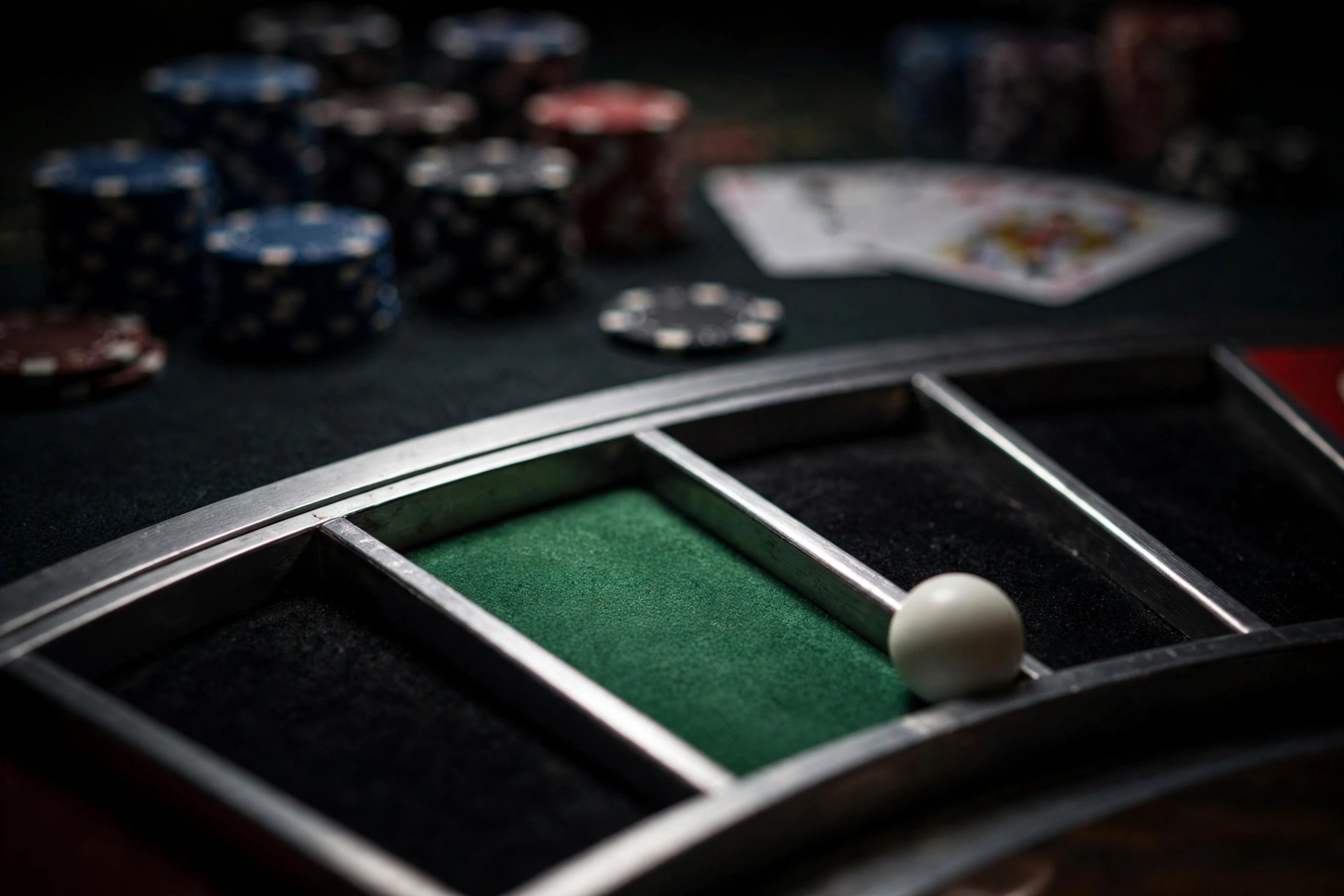
If you’ve ever left a casino feeling like the whole place was designed to separate you from your money, you’re not imagining it. It is. Not through rigged games or loaded dice — through something much quieter: a small mathematical tilt built into every bet you’ll ever place. The house edge. It is the single most important concept in gambling, and once you genuinely understand it, the way you look at casino games changes forever.
I didn’t understand it for a long time. I used to think a game that “pays fairly” meant the casino broke even. It took me a while to grasp that the casino never breaks even — it wins a little on every wager, millions of times a day, and that’s the entire business model. So if you’ve ever asked yourself “what is casino house edge”, this guide answers it properly, in plain English.
Table of Contents
What Is Casino House Edge? The Plain-English Definition
The house edge is the casino’s built-in mathematical advantage, expressed as a percentage of each wager that the casino expects to keep over the long run. That last part matters: “expects to keep over the long run.” It is not a fee charged per bet. It’s not a deduction from your winnings. It is a statistical tendency, averaged across millions of bets.
Think of it like this. If a game has a house edge of 2.7%, the casino doesn’t take 2.7% of your chips every time you bet. It means that if you bet $1 on that game a million times, you’d expect to end up roughly $27,000 poorer — the casino keeps about 2.7 cents of every dollar wagered, on average, over a huge number of bets. In any single session you might win big or lose everything; the edge only shows its face across enormous sample sizes.
How the House Edge Is Calculated: The Roulette Example
The edge is created the same way in almost every casino game: the casino pays you slightly less than the true odds of the event would justify. The gap between the true odds and the payout odds is where the casino lives. Let me make it concrete with the clearest example I know — European roulette.
A European roulette wheel has 37 pockets: the numbers 1 through 36, plus a single green zero. If you bet on a single number and it hits, the casino pays you 35 to 1. That sounds generous until you do the arithmetic.
Imagine you placed $1 on every single number — all 37 pockets covered, a total stake of $37. One of your bets is guaranteed to win. That winning bet pays 35 to 1, which returns your $1 stake plus $35 in winnings — $36 total. But you staked $37 to get there. You’re down $1 no matter what the wheel does.
That missing dollar, divided by the $37 staked, is 1/37 — about 2.7%. That is the house edge on every single-number bet in European roulette. The wheel doesn’t need to be rigged. The math does the work all by itself.
House Edge vs RTP: Two Sides of the Same Coin
You’ve probably seen “RTP” plastered across slot machine descriptions and wondered what it has to do with the house edge. They’re the same thing viewed from opposite ends. RTP stands for “return to player,” and the relationship is beautifully simple: RTP = 100% minus the house edge.
So a slot machine with a 96% RTP has a 4% house edge. A blackjack table with a 0.5% edge returns 99.5% to players in the long run. Casinos marketing a slot tend to advertise the RTP (96% sounds generous), while serious gamblers talk in terms of edge (4% sounds steep). Same number, different framing.
One thing to get straight about both figures: they are long-term averages computed over millions of rounds. A 96% RTP does not mean you’ll get back $96 of your $100 tonight. You could hit the jackpot in ten spins, or you could burn through $200 without a meaningful win. The edge is a promise about the casino’s future, not about yours.
House Edge by Game: An Honest Comparison
Not all casino games are created equal, and the differences are bigger than most players realize. Here’s what you’re actually up against in the most common games, assuming sensible play:
Blackjack (basic strategy): ~0.5% — The lowest edge in the casino, but only if you play every hand according to basic strategy. Deviate from it and the edge climbs.
Baccarat (banker bet): ~1.06% — The banker bet is one of the best wagers in the house. The player bet runs about 1.24%. The tie bet? Over 14%. Don’t.
Craps (pass line): ~1.41% — The pass line with odds behind it is one of the great bets in gambling. The proposition bets in the middle of the table, though, can carry edges of 10-16%.
European roulette: ~2.7% — One zero, as we worked through above.
American roulette: ~5.26% — Two zeros nearly doubles the edge. Same game, same excitement, twice the cost.
Slot machines: ~2-15% — Slots vary enormously. Well-regulated online slots often run 4-6%; some land-based machines are far worse. Because spin speeds are high, that edge eats through money faster than the percentage alone suggests.
Keno: ~20-40% — Keno is effectively a lottery. Fun for a laugh, but understand that you’re donating a quarter or more of every dollar to the house.
Look at that list and the takeaway should be obvious: playing blackjack well costs you roughly one-fortieth of what playing keno costs you per dollar wagered. The game you choose is the single biggest decision you make in a casino.
The Edge Applies to Total Wagers, Not Your Bankroll
This is the point most people get wrong, and it’s the one that costs them money. The house edge is calculated on the total amount you wager — not on the money you walked in with. Your chips get recycled. You bet, you win some back, you bet again. The same $100 can easily be wagered ten times over in an evening.
Here’s the math that surprised me when I first saw it. Suppose you bring $100 to a European roulette table with its 2.7% edge. Over the course of the night, wins and losses recycle your chips and you end up placing $1,000 worth of bets in total. Your expected loss isn’t 2.7% of $100 — it’s 2.7% of $1,000, which is $27. The edge compounds on turnover, and casinos are engineered to maximize turnover: fast games, free drinks, no clocks, easy rebuys.
This also explains why bonus wagering requirements cost more than they look. I explained no deposit bonuses here — wagering requirements multiply the edge’s cost. If a bonus requires you to wager 40 times its value before you can withdraw, that forced turnover gives the house edge 40 chances to grind against your money. A $50 bonus with 40x wagering means $2,000 in required bets; on a 4% edge slot, that’s an expected cost of $80 — more than the bonus was worth. The bonus was never really free; the edge makes sure of it.
One related term worth knowing: the “hold.” Hold is the percentage of your buy-in the casino actually keeps — typically 15-25% on table games, far larger than the edge. It’s not proof the games are crooked; it’s the same edge multiplied by recycling. In our example above, the casino kept $27 of the original $100 buy-in — a 27% hold — while the game’s edge was only 2.7%. Hold is a business metric about how the casino performed; edge is a math fact about the game. Don’t confuse them.
Skill vs Fixed Edge: Where You Can Actually Help Yourself
Some games let you shrink the edge with good decisions; others don’t care what you do. Knowing which is which saves you a lot of wasted effort.
Blackjack is the classic skill game. The ~0.5% edge assumes you’re playing perfect basic strategy — hitting, standing, doubling and splitting by the book on every hand. Every mistake you make hands some of that edge back to the house. Guessing, playing hunches, or “going with your gut” can easily push your real edge to 2% or worse. Your decisions matter here, enormously.
Roulette and craps are fixed-edge games. No betting system — no Martingale, no Fibonacci, no “due number” theory — changes the edge by a single decimal point. Doubling your bet after a loss doesn’t alter the 2.7%; it just changes the shape of your wins and losses while the edge grinds on unchanged. You can choose the better bet (European over American roulette, pass line over prop bets), but once the bet is chosen, your fate is in the math’s hands.
Slots sit in between in a limited way: choosing a machine with a higher RTP is a genuine decision, and sites like Wizard of Odds publish analysis of how slot math actually works. But no timing trick, hot-machine theory, or spin pattern changes the edge on the machine you’ve picked.
How to Use This Knowledge Practically
Understanding the house edge won’t make you a winning player — nothing does, and anyone selling you a system that claims otherwise is selling you something else. But it will make you a much cheaper loser. Here’s how I apply it:
Pick low-edge games. Blackjack with basic strategy, baccarat banker, craps pass line with odds. Skip American roulette when European is available, skip keno unless you treat it as buying a lottery ticket, and check slot RTPs before you commit.
Respect variance. The edge guarantees the casino wins eventually; it guarantees nothing about tonight. Short-term swings are brutal and normal. A low edge doesn’t mean a gentle evening — it just means the grind is slower.
Set loss limits before you start. Decide the number you’re willing to lose and stop when you hit it. The edge means that the longer you play, the more likely the math catches up with you — every additional hour is more turnover for the edge to feed on.
Ignore betting systems. No progression of bet sizes changes the edge. Systems redistribute wins and losses; they don’t reduce the house’s cut. The Martingale in particular is dangerous: it manufactures frequent small wins and occasional catastrophic losses, which feels like skill right up until it isn’t.
Myths Busted
Let’s clear out a few persistent ones, because they cost people real money.
“The casino flips a switch to make you lose.” No. The edge is already the switch, and it’s permanently on. Regulated casinos have no need to cheat — the math is more reliable than any rigging could be, and getting caught would cost them their license.
“I’m due for a win after a losing streak.” Every spin, roll, and deal is independent (in games of independent trials, which is nearly all of them). The wheel has no memory. The edge doesn’t owe you anything, and past results don’t change future probabilities.
“Short sessions beat the edge.” Short sessions mean less turnover, which means the edge has less to grind on — that’s true. But a short session doesn’t change the edge; it just gives variance more room to surprise you. You’re just as likely to be down as up.
“Card counting erases the edge.” Card counting can genuinely flip blackjack’s edge in a skilled player’s favor — it’s real, and it’s why casinos watch for it. But it’s brutally difficult to do profitably, requires a large bankroll and hundreds of hours of practice, and online games shuffle every hand, making it impossible there. For everyone else, it’s a fantasy, not a plan.
Final Thoughts
The house edge is the most honest thing in the casino. It’s printed in the math of every game, it never hides, and it never takes a night off. Casinos don’t beat you with tricks; they beat you with patience, running a small edge across an enormous number of bets until the outcome is a certainty. That’s what is casino house edge, at its core — a small, honest, permanent tilt in the casino’s favor.
I find that weirdly liberating. Once you accept the edge as the price of admission — the entertainment cost of the evening, like a concert ticket — you can stop fighting it and start managing it. Choose the games that charge you the least, keep your turnover modest, set your limits, and treat any win as a happy accident of variance rather than proof of a system.
Gamble responsibly. 18+ only.
6 comments