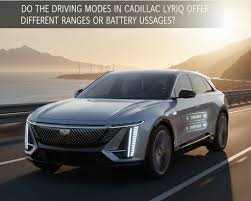
If you are trying to understand whether the Driving Modes in the Cadillac LYRIQ change range, the practical answer is yes, but not in the simple “each mode gets its own official range number” way many drivers expect. Cadillac’s current LYRIQ pages publish range by drivetrain and trim, with the 2026 LYRIQ single-motor RWD rated at up to 326 miles EPA-estimated and the dual-motor AWD model rated at up to 319 miles EPA-estimated, while the performance-focused LYRIQ-V is rated at 285 miles EPA-estimated. Cadillac’s mode guides describe Driver Mode Control as a way to tailor performance to road conditions and driving preferences, which means the modes mainly change acceleration feel, steering, traction behavior, and performance response rather than creating a separate EPA range label for each mode.
That distinction matters because it clears up the biggest misunderstanding around electric vehicles. On the LYRIQ, do the driving modes in Cadillac LYRIQ offer different ranges or battery usages? you select does not magically add or subtract a fixed amount of battery capacity from the pack. Instead, it chan ges how the car uses the battery, how quickly it responds, and how aggressively it sends power to the wheels. Cadillac’s own mode descriptions make that clear: Tour is meant for normal acceleration and comfortable everyday driving, Sport tightens steering and sharpens response, Snow/Ice softens pedal response to help prevent wheel slip, and other modes such as Weather, Off-Road, Terrain, and Tow/Haul are designed around traction, load, or surface conditions. Those settings can influence real-world energy use, but they are not presented by Cadillac as separate official range ratings.
The LYRIQ’s current mode lineup is broader than many people realize, and that breadth is part of why the answer is not just “yes” or “no.” Cadillac says the available modes depend on model and equipment, but they may include Tour, Sport, Tow/Haul, AWD, Snow/Ice, Off-Road, Terrain, My Mode, Z Mode or V Mode, Track Mode, and Weather. Tour is the baseline everyday setup; Sport is tuned for a more spirited feel; Tow/Haul is designed to improve the drive when pulling a trailer or heavy load; AWD engages the rear wheels to help on wet, snowy, or icy roads; Snow/Ice and Weather slow acceleration and torque response; Off-Road and Terrain are built for gravel, sand, mud, and uneven surfaces; My Mode is customizable; and V Mode or Z Mode is Cadillac’s peak-performance customization path on equipped models. In other words, Cadillac is telling drivers that some modes are about efficiency and composure, while others are about control or performance. That directly affects how much energy the vehicle is likely to draw in normal use.
For everyday driving, Tour is the most range-friendly starting point in spirit because Cadillac describes it as providing normal acceleration and comfortable ride tuning for routine use. That matters because rapid acceleration is one of the easiest ways to increase energy consumption in any EV. Sport, by contrast, is built to tighten steering response and deliver a more responsive suspension and powertrain calibration for a sportier feel on dry roads. The car is not literally “losing battery” because the mode name changed, but the calibration encourages the kind of driving that can use more energy per mile. Snow/Ice and Weather can do the opposite in one important way: they soften throttle progression and torque response to help prevent wheel slip, which can make the vehicle feel less aggressive and, in many situations, more controlled on slippery roads. Cadillac’s own descriptions point to a clear pattern: the more the mode emphasizes sharp power delivery, the more likely it is to increase battery usage in real-world driving.
The most important battery-related distinction is between ordinary drive modes and the LYRIQ’s dedicated performance features. Cadillac says Velocity Max unlocks additional horsepower and torque from the vehicle’s battery and electric drive units, enabling more aggressive power and acceleration. Cadillac is explicit that this feature draws more energy from the battery than regular driving and that repeated use can drain battery power faster. On the 2026 LYRIQ-V page, Cadillac says Velocity Max enables an estimated 615 horsepower and 650 lb.-ft. of torque, with 0–60 mph in 3.3 seconds, and the vehicle’s range is listed at 285 miles EPA-estimated. That is the clearest official signal that performance-oriented features can have a meaningful effect on range and battery usage. If you want the longest possible day-to-day distance between charges, this is the kind of feature you would reserve for special moments rather than daily commuting.
Cadillac’s V-Series language makes the same point differently. The 2026 LYRIQ-V page says the performance steering wheel gives access to V-Mode, an exclusive customizable setting, and the driver modes section says V-Mode allows access to Launch Control and Competitive Mode. That is a very different design philosophy from Tour or even Weather mode. It is built for maximum response, not maximum efficiency. Cadillac also says the LYRIQ-V’s driving experience is “the quickest Cadillac ever,” which reinforces that its top priority is performance. When a vehicle is tuned around launch control, aggressive throttle mapping, and high output from the battery and motors, battery usage will naturally be higher than in an efficiency-first setup. That does not mean the LYRIQ-V is inefficient in an absolute sense; it means its performance envelope is designed to trade some range for speed and response.
The LYRIQ also includes regenerative tools that can help recover some energy instead of wasting it as heat. Cadillac says regenerative braking captures braking energy for added range, and its One-Pedal Driving guide explains that the vehicle can slow and stop using only the accelerator pedal under normal driving conditions. Cadillac also says Regen On Demand uses a paddle on the steering wheel to slow the vehicle and return energy to the battery. This matters because regen can partially offset the energy used during acceleration, especially in city driving or traffic where you are slowing down often. It does not turn a performance mode into an efficiency mode, but it does help the LYRIQ reclaim energy that would otherwise be lost. In a practical sense, a driver who uses Tour mode with strong regenerative braking will usually stretch range farther than a driver who uses Sport or Velocity Max aggressively, even though both are using the same battery pack.
Battery care also plays a role in how you think about range. Cadillac recommends charging to 80% for daily use to help maintain battery health and says that higher charge levels are more appropriate for longer trips. Its EV maintenance guidance says daily charging between 20% and 80% helps reduce stress on the battery, and the One-Pedal Driving guide repeats that 80% is ideal for daily use while charge above that can be used for extended range. Cadillac also notes that charging to 80% can support optimal regenerative braking performance. That means range is not just about mode selection; it is also about how you charge and how you plan the trip. A thoughtful owner who uses Tour, strong regen, and sensible charge habits will generally get more usable miles from each charging session than a driver who constantly chooses performance modes and charges without a strategy.
When you look at Cadillac’s official range figures, the pattern becomes very clear: range is mainly a function of drivetrain and model, not a separate mode setting. The 2026 LYRIQ’s current pages show up to 326 miles EPA-estimated for the single-motor RWD model and 319 miles EPA-estimated for the dual-motor AWD model, with the LYRIQ-V at 285 miles EPA-estimated. Cadillac also lists the LYRIQ battery platform at 102 kWh rated energy capacity. Those numbers are the baseline. The drive modes influence how quickly you move through that battery reserve, but they do not change the official rated size of the pack or create a different EPA label for each mode. So if you are shopping or comparing trims, the drivetrain choice matters much more for official range than whether you plan to spend most of your time in Tour, Sport, or Weather.
That leads to the most useful real-world answer: yes, the driving mode can affect the battery you use on a trip, but the effect is indirect. Cadillac’s descriptions show that some modes sharpen power delivery and others reduce wheel slip or alter traction behavior. From that, the reasonable inference is that Sport, Track, Velocity Max, and V Mode are more likely to increase battery usage because they encourage or enable stronger performance, while Tour, Snow/Ice, Weather, and a careful use of regen and One-Pedal Driving are more likely to help preserve range in normal use. That is not a laboratory claim; it is an operating reality based on how EVs consume energy. More acceleration, more aggressive response, and more high-power demand from the motor usually means more battery drain, especially at highway speeds, in cold weather, or in hilly terrain.
In city driving, the LYRIQ gives you more chances to recover energy than on the highway, so mode choice can feel even more meaningful. One-Pedal Driving slows the car when you lift off the accelerator, and Regen On Demand lets you add deceleration with the steering-wheel paddle, both of which return energy to the battery. That makes a calm, anticipatory style of driving especially effective. A driver who stays in Tour, lifts early, and lets the regen work will usually stretch range more efficiently than a driver who frequently accelerates hard in Sport and brakes late. The important point is not that Sport is “bad” or Tour is “good”; the important point is that the LYRIQ rewards matching the mode to the trip. For stop-and-go commuting, Tour plus regen is a smart setup. For a highway merge or a winding back road, Sport may be more enjoyable, even if it costs a little extra energy.
For bad weather, the range conversation becomes more nuanced. Cadillac says AWD engages the rear wheels to help improve driving on paved roads covered with water, snow, or ice, and Snow/Ice and Weather modes slow acceleration or adjust throttle progression to help control wheel speed on slippery roads. Those are safety and traction benefits first, and energy efficiency benefits second. In cold, slippery, or wet conditions, you often need the traction and smoother response more than you need peak range. That is why it is better to think of these modes as confidence modes rather than mileage modes. The LYRIQ is designed to help you stay stable and controlled, and that stability may come with a slight energy tradeoff because the vehicle may need to manage torque more carefully or use AWD hardware more often. Still, in poor weather, the right mode is the one that lets the vehicle put power down safely and predictably.
For towing, hauling, or heavier loads, the same idea applies. Cadillac says Tow/Haul keeps the vehicle in a lower gear for more torque and holds lower gears longer to prevent excessive shifting. Even though the LYRIQ is an EV and does not behave exactly like a gasoline truck with a multi-speed transmission, the official language shows the general intent: the vehicle is optimizing itself for load handling rather than efficiency. A heavier trailer, more cargo, steeper grades, and stronger acceleration all put extra demand on the battery. That means range will typically fall when Tow/Haul or performance-oriented settings are used under load, but that is not a flaw. It is the expected tradeoff when you ask the vehicle to do more work. For owners who plan to tow or carry heavy loads, the better strategy is to accept a shorter range estimate and plan charging accordingly instead of expecting Tour mode to overcome the physics of extra weight and resistance.
My recommendation for most LYRIQ owners is simple. Use Tour as the default mode for everyday commuting, errands, and road trips when comfort and steady range matter most. Use Snow/Ice or Weather when conditions call for gentler throttle response and better traction management. Use AWD when the road surface demands it. Reserve Sport, Track, V Mode, and Velocity Max for the moments when you actually want the extra urgency and are willing to spend battery faster to get it. Cadillac’s own feature descriptions make that strategy the most sensible one. The brand has clearly designed the LYRIQ to be flexible, but not every mode serves the same purpose. If your goal is to maximize usable miles, the best habit is not simply choosing one mode forever. It is matching the mode to the route, the weather, and the job the car has to do that day.
So, do the driving modes in Cadillac LYRIQ offer different ranges or battery usages? The honest, practical answer is that they affect battery usage more than they affect the official range number. Cadillac’s published range is tied to the LYRIQ’s drivetrain and trim, not to a separate range rating for every mode. But the mode you choose absolutely changes how the battery is used in the real world. Gentle modes, strong regen, and sensible charging habits can help you preserve more range, while performance modes such as Sport, Track, V Mode, and especially Velocity Max can drain the battery faster because they unlock more power and quicker acceleration. If you own a LYRIQ or are thinking about buying one, that is the key insight that matters most.
If you are shopping for a Cadillac LYRIQ, the smartest next step is to decide what matters more in your daily life: maximum range, sharper performance, or all-weather confidence. Then test those conditions in the trim and mode that match your routine. A real drive tells you far more than a spec sheet ever can, especially on a vehicle as configurable as the LYRIQ. Book a test drive, switch between Tour and Sport, feel how regen changes your driving style, and compare how the car responds in different conditions. That is the easiest way to discover the mode that gives you the best balance of comfort, confidence, and battery efficiency for your needs.



Post Comment