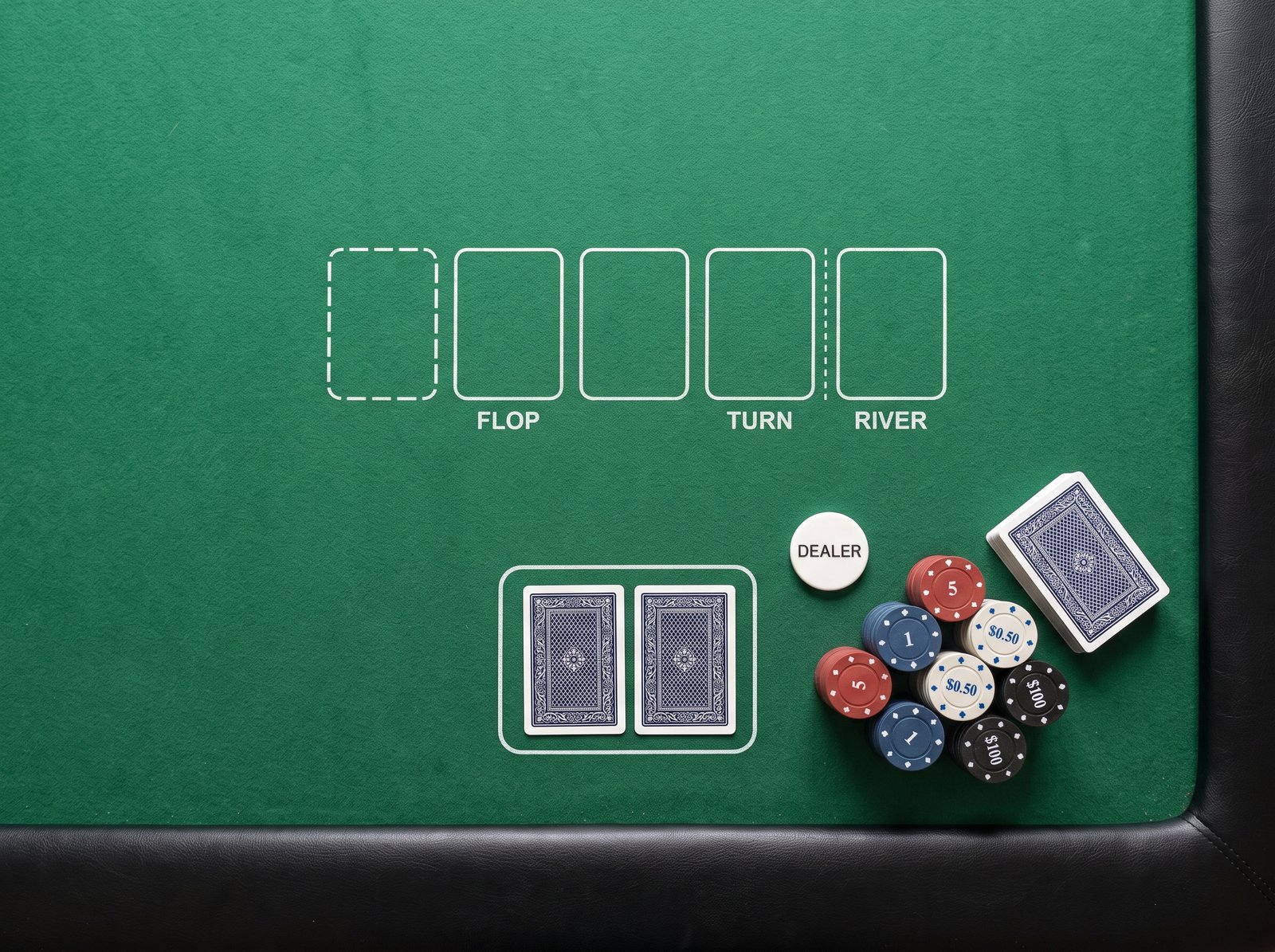
Poker rules can look confusing when you first see cards, chips, blinds, bets, raises, and unfamiliar words such as flop and river. The basic idea is much simpler than it seems. In Texas Hold’em, each player receives two private cards. Up to five community cards are then placed face up on the table. Players try to make the strongest five-card poker hand, or they can win earlier if every opponent folds.
Table of Contents
There are many forms of poker, so not every poker game follows exactly the same rules. This beginner guide focuses mainly on standard Texas Hold’em because it provides a useful introduction to common poker ideas such as blinds, betting rounds, community cards, hand rankings, checking, calling, raising, folding, and showdown.
Texas Hold’em normally has four betting rounds: pre-flop, flop, turn, and river. Players can use both of their private cards, one of them, or neither of them when making their final five-card hand. You can review the detailed rules in the PokerStars Texas Hold’em rules guide.
The important point for beginners is that poker is not about collecting seven cards and comparing all seven. Only the best five-card combination counts.
1. Understand the Main Goal of Poker
The first poker rule to learn is how a hand is actually won.
There are two main ways.
You can reach the end of the hand, known as the showdown, and hold the strongest five-card hand. Or you can make every other player fold before showdown. In that situation, you win the pot without having to show a better hand.
The pot is the collection of chips or stakes that players have placed into the middle during the hand.
Suppose three players are still involved. Player A bets. Player B folds. Player C also folds. Player A wins the pot immediately. It does not matter whether Player A actually had a strong hand because nobody remained to challenge it.
If Player C had called instead, the hand might have continued to showdown, where the cards would determine the winner.
This is why poker involves more than simply waiting for strong cards. However, beginners should first concentrate on understanding the rules and hand rankings before worrying about advanced strategy or bluffing.
2. Learn the Poker Hand Rankings
Knowing what beats what is one of the most important poker rules.
In standard high-hand Texas Hold’em, poker hands are ranked from strongest to weakest. PokerStars’ current hand-ranking guidance confirms the traditional order used in Hold’em.
| Rank | Poker Hand | Simple Explanation |
|---|---|---|
| 1 | Royal Flush | A, K, Q, J, 10 of the same suit |
| 2 | Straight Flush | Five consecutive cards of the same suit |
| 3 | Four of a Kind | Four cards of the same rank |
| 4 | Full House | Three of one rank plus two of another |
| 5 | Flush | Five cards of the same suit |
| 6 | Straight | Five consecutive card ranks |
| 7 | Three of a Kind | Three cards of the same rank |
| 8 | Two Pair | Two separate pairs |
| 9 | One Pair | Two cards of the same rank |
| 10 | High Card | No pair or stronger combination |
A royal flush is really the highest possible straight flush: 10-J-Q-K-A, all of one suit.
A straight does not need to use the same suit. For example, 5♠ 6♥ 7♦ 8♣ 9♥ is a nine-high straight.
The ace has a special role in a straight. It may sit above the king in 10-J-Q-K-A or below the two in A-2-3-4-5. It cannot wrap around in a sequence such as Q-K-A-2-3.
Why Five Cards Matter
Imagine the board is:
A♠ K♦ 10♣ 7♥ 4♣
Player 1 holds:
A♥ Q♠
Player 2 holds:
A♦ J♠
Both players have a pair of aces. The remaining cards are then compared.
Player 1 can make:
A-A-K-Q-10
Player 2 can make:
A-A-K-J-10
Player 1 wins because the queen kicker beats the jack kicker.
This extra card used to break certain ties is commonly called a kicker.
3. Know the Dealer Button and Blinds
A standard Texas Hold’em hand normally uses a dealer button and two forced bets called blinds.
The dealer button is a small marker showing the nominal dealer position. After each completed hand, the button normally moves clockwise to the next player.
The player immediately to the left of the button posts the small blind. The next player posts the big blind. These forced bets create something worth competing for before the cards are dealt.
For a simple hypothetical example, imagine the blinds are 1 and 2 chips.
The small blind puts in 1 chip.
The big blind puts in 2 chips.
Every player then receives two private cards.
The blind amounts depend on the game. In cash games they are linked to the table stakes. In tournaments they normally rise as the event progresses.
Beginners sometimes confuse the dealer button with the person physically dealing the cards. In casinos and online poker, a professional or automated dealer may handle the cards. The button mainly determines position and the order of play.
4. Follow the Pre-Flop Betting Round
Once the blinds are posted, every player receives two cards face down. These are called hole cards.
Only the player who receives them should normally know what they are.
The first betting round is called pre-flop because it happens before any community cards appear.
Players now decide whether to fold, call, or raise.
If the big blind is 2 chips and nobody has raised, a player who wants to stay in generally needs to match that 2-chip amount by calling. A player may instead raise, subject to the betting structure and house rules.
After the action reaches the blinds, they also get a chance to respond where required.
When all active players have contributed the required amount or folded, the pre-flop betting round ends.
This is one area where beginners should slow down. Watch whose turn it is before touching your chips.
Current Poker Tournament Directors Association rules state that tournament players should act in turn and that actions made in turn can be binding. See the 2026 Poker TDA rules for formal live-tournament procedures.
5. Play the Flop
After the first betting round is complete, the flop is dealt.
The flop consists of three community cards placed face up in the middle of the table.
For example:
K♠ 9♦ 4♣
Everyone still in the hand can use these cards.
If your private cards are:
K♥ J♥
you currently have a pair of kings because one king is in your hand and another is on the board.
Another betting round now takes place.
After the flop, players may often have the option to check if nobody has bet before them.
Checking means staying in the hand without placing a new bet. It passes the action to the next player.
You cannot normally check when you are already facing a bet. If someone has bet before you, you generally need to call, raise, or fold.
The post-flop action normally starts with the active player immediately clockwise from the dealer button.
6. Play the Turn
When the flop betting round finishes, another community card is dealt.
This fourth community card is called the turn, sometimes called fourth street.
Suppose the board was:
K♠ 9♦ 4♣
and the turn is:
J♣
The board is now:
K♠ 9♦ 4♣ J♣
Players reassess their hands using the new card, and another betting round begins.
Your hand can change a great deal when a new community card arrives.
For example, if your private cards were K♥ J♥, you had one pair after the flop. The jack on the turn now gives you two pair: kings and jacks.
The important rule is that nothing is permanently decided until either everybody else folds or all relevant community cards and betting rounds have been completed.
7. Play the River and Reach Showdown
The final community card is called the river.
Once it is dealt, the board contains five community cards.
Using the previous example, imagine the river is:
2♠
The complete board becomes:
K♠ 9♦ 4♣ J♣ 2♠
A final betting round now takes place.
If only one player remains because everybody else folds, that player wins immediately.
If two or more players remain after the final betting round, the hand reaches showdown.
At showdown, each player makes the strongest possible five-card hand using any combination of their two private cards and the five community cards.
You Do Not Have to Use Both Hole Cards
This is one of the most commonly misunderstood poker rules.
In Texas Hold’em, you are not required to use both private cards.
You can use:
both hole cards,
one hole card,
or no hole cards.
Suppose the community cards are:
A♠ K♠ Q♠ J♠ 10♠
The board itself is a royal flush.
Every remaining player therefore has the same five-card royal flush, regardless of their private cards. Because suits do not break ties in standard Hold’em, the pot would be split between the tied players.
8. Understand Check, Bet, Call, Raise, Fold, and All-In
Poker becomes much easier when you know the basic actions.
Check
A check means you stay in the hand without making a bet during that action.
You can normally check only when no bet is currently facing you.
Bet
A bet is the first wager made during a betting round after no previous player has bet.
For example, everyone checks to you on the flop and you put 10 chips into the pot. You have made a bet of 10.
Call
A call means matching the amount you are required to match in order to remain in the hand.
If another player bets 10 chips and you put in 10 chips, you have called.
Raise
A raise increases the amount other players must match.
Suppose Player A bets 10. Instead of simply calling 10, Player B raises to a larger valid total.
Minimum-raise rules can become more detailed when previous raises or short all-ins are involved, so beginners playing an organised live event should follow the specific house or tournament rules rather than guessing.
Fold
A fold means giving up your hand.
Once you properly fold, you are no longer competing for that pot.
Folding is a normal part of poker. You do not have to keep calling just because you already placed chips in the pot earlier.
All-In
Going all-in means wagering all the chips you currently have available in front of you.
An all-in can lead to main and side pots when different players have different stack sizes.
Formal tournament procedures become more detailed in these situations. Under the current Poker TDA rules, when a player is all-in and all further betting action is complete, relevant hands are tabled for the remaining runout and showdown.
9. Learn Ties, Split Pots, Main Pots, and Side Pots
Poker does not always produce one winner.
What Happens When Two Players Have the Same Hand?
The best five cards are compared.
If the two players have exactly the same five-card hand, the pot is divided between them.
Suits do not rank above one another in standard Texas Hold’em. A spade flush does not automatically beat a heart flush just because it is made with spades. The card ranks determine which flush is stronger.
Suppose the board is:
A♣ A♦ K♠ K♥ Q♣
Player 1 holds 7♠ 6♠.
Player 2 holds 5♥ 4♥.
Neither player’s private cards improve the board.
Both therefore have:
A-A-K-K-Q
The pot is split.
What Is a Side Pot?
Side pots appear when one player cannot match the full amount wagered by other players.
Imagine three players:
Player A has 50 chips.
Player B has 100 chips.
Player C has 100 chips.
If all three commit their chips, Player A can only compete for the portion of the pot that Player A was able to match. Additional chips committed by Players B and C form a separate side pot.
It is therefore possible for one player to win the main pot while another player wins a side pot.
Beginners do not need to calculate complicated multi-player side pots by hand in a casino or online game, because the dealer or software generally manages them. You should still understand why more than one pot can appear.
10. Follow Live Poker Procedures and Table Etiquette
Knowing the cards is only part of playing correctly in a live game.
Tournament and casino poker can have detailed rules for betting declarations, chip movements, exposed cards, showdown order, misdeals, and other unusual situations.
The Poker TDA released its 2026 Rules Version 1.0 on September 7, 2026, providing a current set of widely used tournament procedures.
One simple rule is especially useful for beginners: make your action clear.
If you want to call, say “call.”
If you want to raise, clearly announce “raise” before making a potentially confusing chip movement.
Poker TDA rules state that verbal declarations such as “call” or “raise” made in turn can bind the player to that action.
Avoid String Bets
A string bet happens when someone puts some chips forward and then returns to their stack to add more chips as part of the same undeclared wager.
Current TDA tournament rules do not allow string bets and raises.
For a beginner, the simple solution is to announce your intended action clearly before moving chips when there could be confusion.
Protect Your Cards
Do not assume everyone else is responsible for your hand.
Current TDA guidance lists protecting your hand, following the action, acting in turn, making intentions clear, and keeping cards visible among player responsibilities.
House rules still matter. A casino, home game, poker room, or online operator may use procedures that differ in some details.
A Complete Texas Hold’em Example
A short example can make the poker rules easier to remember.
Four players sit at a table.
The blinds are 1 and 2 chips.
Player A has the dealer button. Player B posts the small blind of 1. Player C posts the big blind of 2.
Everyone receives two private cards.
Player D is first to act before the flop.
Suppose Player D calls 2.
Player A calls 2.
Player B adds the amount needed to stay in.
Player C checks because the big blind has already met the current amount and nobody has raised.
The flop comes:
Q♠ 8♥ 3♦
Player B checks.
Player C checks.
Player D bets 4.
Player A calls.
Players B and C fold.
Two players remain.
The turn is:
10♣
Player D checks.
Player A checks.
The river is:
2♥
Player D bets 6.
Player A calls.
They reach showdown.
Player D reveals:
Q♦ 9♦
Player A reveals:
Q♥ J♠
Both players have one pair: queens.
Now the remaining cards matter.
Player D’s best five cards are approximately:
Q-Q-10-9-8
Player A can make:
Q-Q-J-10-8
Player A wins because the jack kicker beats the nine.
This example shows why simply saying “both players have a pair of queens” is not enough. Poker compares the entire best five-card hand.
Common Poker Rules Beginners Get Wrong
One frequent mistake is thinking you must use both hole cards. That rule applies to some other poker variants, but not Texas Hold’em. In Hold’em, your best five cards can use zero, one, or two hole cards.
Another mistake is thinking three pairs make a special hand. They do not. A poker hand contains only five cards. If seven available cards contain three pairs, you use the two strongest pairs plus the best remaining kicker.
Beginners also sometimes think every ace must be high. The ace can be low in the A-2-3-4-5 straight.
Another common misunderstanding is believing suits break a tie. In standard Texas Hold’em hand rankings, suits are equal.
Finally, players sometimes expose or throw away their cards before understanding what has happened. In a live game, protect your hand and wait until the action is clear.
Texas Hold’em vs Other Poker Variants
The phrase poker rules can refer to many games.
Texas Hold’em is only one version.
Omaha
Omaha also uses community cards, but players receive more private cards. A major rule difference is that standard Omaha requires players to use exactly two hole cards and exactly three community cards when building their final hand.
That means you should not automatically apply Texas Hold’em’s “use any five from seven” rule to Omaha.
Seven Card Stud
Stud does not use the same five-card community board found in Hold’em. Players receive their own combination of face-up and face-down cards across several betting rounds.
Short Deck Poker
Short Deck removes lower-ranked cards from the standard deck. Because the deck composition changes, some commonly used Short Deck hand rankings can differ from ordinary Texas Hold’em.
Always check the specific variant before starting.
Cash Games and Poker Tournaments Are Not the Same
The card rules may be similar, but the structure differs.
In a cash game, chips generally represent the stakes being played at the table, and blinds usually stay at the chosen level unless the game changes.
In a tournament, players receive tournament chips and try to remain in the event while blinds and sometimes antes increase according to a schedule.
A player who loses all tournament chips is normally eliminated unless the tournament structure permits a re-entry or similar option.
Tournament chips should not be confused with cash.
Formal tournaments also tend to have stricter procedures for situations such as acting out of turn, chip declarations, showdown order, player movement between tables, and all-in action.
Poker Rules and Responsible Real-Money Play
Understanding poker rules does not make poker a reliable way to earn money.
Poker includes both skill and chance. The UK Gambling Commission describes poker as involving elements of both and treats it as a game of chance for the purposes of the Gambling Act.
If you play only to learn the game, you can use play chips, cards at home, or free practice where legally available.
If you choose real-money poker, check the rules and legal requirements that apply where you are located.
In Great Britain, online gambling businesses must verify a customer’s age and identity before allowing that customer to gamble. You can read the regulator’s age and identity verification guidance.
In the United States, gambling regulation varies between states, and regulated online poker availability is not uniform nationwide. The American Gaming Association’s current state reporting shows significant differences in state online-gaming frameworks.
If you gamble for money, decide beforehand what you can afford to lose and do not treat poker as a guaranteed source of income. Do not chase losses by increasing stakes simply to recover previous losses.
For U.S. support relating to gambling problems, the National Council on Problem Gambling provides confidential help resources, including its national helpline. National Council on Problem Gambling resources
FAQ About Poker Rules
What are the basic poker rules for beginners?
In Texas Hold’em, each player receives two private cards. Five community cards may be dealt across the flop, turn, and river. There are four betting rounds. Players either win by making everybody else fold or by showing the strongest five-card hand at showdown.
How many cards do you get in Texas Hold’em?
Each player receives two private hole cards. Up to five community cards are then dealt on the board. This gives each player access to as many as seven cards from which the best five-card hand is selected.
Does a flush beat a straight?
Yes. Under standard Texas Hold’em hand rankings, a flush ranks above a straight. A full house ranks above a flush.
Does three of a kind beat two pair?
Yes. Three of a kind ranks above two pair and below a straight.
Can you use only the cards on the table?
Yes. In Texas Hold’em, if the five community cards make your strongest possible five-card hand, you can “play the board” and use none of your hole cards. If another player has exactly the same best five cards, the pot is split.
Is an ace high or low in poker?
An ace is normally the highest rank, but in a straight it can also act as the low card in A-2-3-4-5. It cannot connect the king to the two in a wraparound straight.
Who acts first in Texas Hold’em?
The answer depends on the stage of the hand. The blind positions affect the pre-flop order. After the flop, betting normally begins with the first active player immediately clockwise from the dealer button.
Do poker suits have different values?
Not for determining the winning hand in standard Texas Hold’em. Spades, hearts, diamonds, and clubs have equal hand-ranking value.
Conclusion
Poker rules become much easier once you divide the game into a few basic ideas.
First, learn the hand rankings. Then understand the dealer button and blinds. Follow the four betting stages: pre-flop, flop, turn, and river. Learn the meaning of check, bet, call, raise, fold, and all-in. At showdown, remember that only the strongest five-card combination counts.
After those basics feel natural, you can move on to topics such as position, starting-hand selection, pot odds, tournament structures, and poker strategy.
If you are learning for the first time, start with practice chips rather than focusing on money. Play a few slow hands, identify your best five cards after each street, and use a hand-ranking chart until the order becomes familiar.



Post Comment