Leta Ramirez CeeDee Lamb: Shocking Truth Behind the Viral Dak Prescott Controversy Explained
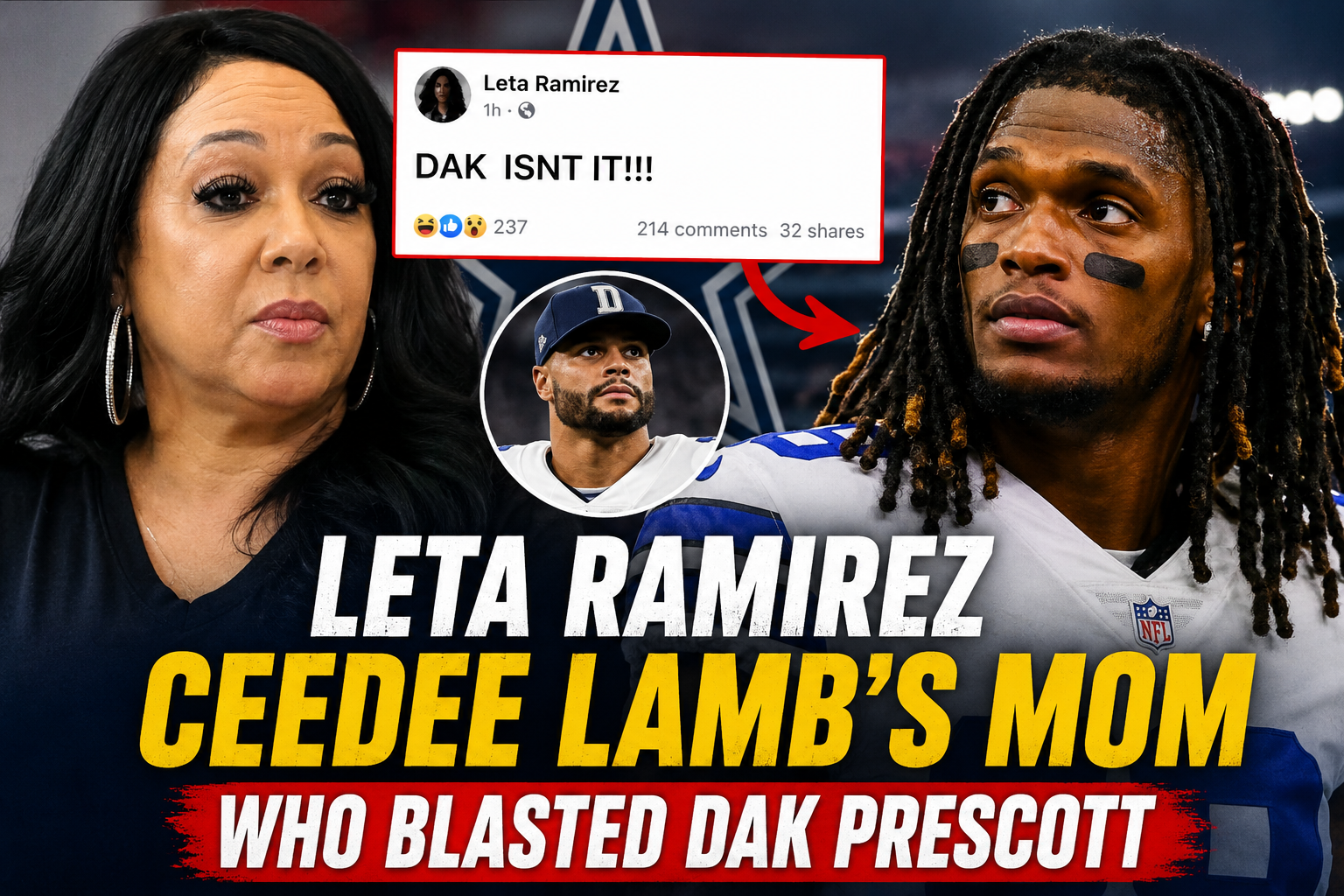
Leta Ramirez became a widely searched name after one blunt social media post pulled her into the middle of a Dallas Cowboys debate that football fans could not stop discussing. The phrase “leta ramirez ceedee lamb” started trending because people wanted to know who she is, why she spoke so strongly about Dak Prescott, and whether her comments reflected a deeper problem inside the Cowboys locker room. What made the story travel so fast was not just the message itself, but the fact that it came from the mother of one of Dallas’s biggest stars, CeeDee Lamb, right after a painful playoff loss. That combination created instant drama, instant speculation, and instant curiosity.
The story gained traction after the Cowboys were knocked out of the playoffs by the Green Bay Packers in a 48-32 loss, a game that intensified criticism of Dallas and especially of Prescott. In the aftermath, Ramirez posted on Facebook that “DAK ISNT IT!!!” and, according to multiple reports, followed up in comments by saying the Cowboys should get rid of Prescott and that he did not want to win a ring.
CBS Sports reported that she also responded to a comment suggesting CeeDee Lamb should play for the Houston Texans, saying she wished he would and calling Texans quarterback C.J. Stroud great. This is the moment that turned Leta Ramirez from a family name into a viral sports headline.
What makes the Leta Ramirez CeeDee Lamb story especially interesting is that it was never just about one angry post. It touched a nerve because Dallas fans were already frustrated, analysts were already questioning the offense, and the Cowboys were already under pressure after another playoff disappointment. Prescott had posted strong regular-season numbers, but the postseason loss reopened the same old conversation about whether Dallas could finally take the next step. That context matters because viral moments almost always spread faster when they land on top of an existing frustration. Ramirez did not create the conversation out of nowhere; she stepped directly into one that was already loud, emotional, and unresolved.
For readers searching this topic, it is important to understand one basic point: most public reporting on Leta Ramirez centers on this social media moment and her connection to CeeDee Lamb. There is not a deep public record of her life in the same way there is for NFL players, so the online spotlight has focused largely on the incident, the response, and the reaction from her son. That is why searches for “leta ramirez ceedee lamb” often return sports articles, commentary, and reposts of the original Facebook criticism. In other words, she became news because of the moment, not because she has spent years in the public eye.
The response from CeeDee Lamb himself helped cool the situation and also clarified that his mother’s opinion was not his own. On Micah Parsons’ podcast, Lamb said he had not been talking to his mother about any of it, explaining that she was “just being a mom” and that he did not discuss sports or personal problems with her.
He added that he had no beef with his quarterback and said he loved Dak Prescott. That was a significant moment because it separated family emotion from team chemistry, which is exactly what Cowboys fans and sports media were trying to figure out. Lamb’s public message was clear: his mother could speak for herself, but he was not turning that into a locker room conflict.
That clarification mattered even more because the Cowboys had already been surrounded by speculation about tension after the playoff loss. Prescott’s performance in the wild-card game was heavily scrutinized, and the team’s collapse against Green Bay created a wave of blame that reached coaching, play-calling, and leadership. In that environment, a family member’s strong criticism could easily be mistaken for proof of a bigger split. Lamb’s comments pushed back against that interpretation and reframed the post as a mother reacting emotionally to a painful defeat rather than a sign of internal rebellion. For a search term like “leta ramirez ceedee lamb,” that nuance is essential, because it helps readers understand the difference between online outrage and actual team dysfunction.
Part of the reason this story spread so widely is that it matched a familiar sports-media pattern: a superstar’s family member says something fiery, fans amplify it, and the internet tries to read deeper meaning into it. The Cowboys are one of the most discussed franchises in football, and Prescott is one of the league’s most polarizing quarterbacks. When those two facts combine with a viral family post, the result is almost guaranteed to explode across social media.
That is exactly what happened here. The comment was sharp, the timing was immediate, and the opponent was already a lightning rod for debate. Ramirez’s words were short, but they landed in a setting where even a few words could carry a lot of weight.
Another reason the Leta Ramirez story got attention is that fans often read a family member’s opinion as a window into the player’s private feelings. That may be tempting, but in this case Lamb directly shut that theory down. He made it clear that his mother was speaking from her own frustration, not as a spokesperson for him or for the locker room. That distinction is especially important in sports because players spend so much of their lives balancing public pressure with private relationships. When a parent comments publicly, the message can feel bigger than intended. Lamb’s response showed a mature attempt to keep the focus on football and avoid turning family emotion into a franchise crisis.
There is also a human side to this story that gets lost when the internet turns everything into a hot take. A parent watching her child lose a major playoff game can react emotionally, especially when that child is one of the team’s top stars and the loss is widely seen as a major failure. That does not automatically make the comment strategic, fair, or even wise, but it does make it understandable.
Sports families live under a different kind of pressure because every mistake, every loss, and every public reaction can become part of a much larger conversation. In that sense, the Leta Ramirez CeeDee Lamb moment was not only about football; it was about emotion, loyalty, and the way family reactions can spill into public view when the stakes are high.
The conversation also exposed how quickly narrative can outrun reality in sports. A strong post can make it seem as though a team is falling apart, but the actual picture is often more complicated. Lamb and Prescott had produced impressive numbers during the 2023 season, and Lamb’s own production helped keep Dallas competitive. CBS Sports noted that Prescott finished the regular season with 4,516 passing yards and 36 touchdowns, while Lamb led the NFL with 135 receptions and finished near the top in receiving yards and touchdowns.
Those numbers do not erase the playoff loss, but they do show why blaming one person or one relationship is usually too simple. The Cowboys’ issues were broader than a single quarterback or a single post.
That is why this story works so well as an SEO topic. People searching “leta ramirez ceedee lamb” are rarely looking for a full biography alone. They want the backstory, the controversy, the response, and the real meaning behind the viral moment. A strong article should answer all of those needs in a way that is clear, honest, and reader-friendly.
It should explain that Ramirez became part of the conversation because she publicly blasted Dak Prescott after the Cowboys’ playoff defeat, that the post spread fast because it fit the emotions of the moment, and that CeeDee Lamb himself later said there was no issue between him and his quarterback. That mix of viral drama and real clarification is exactly what readers are searching for.
If you are writing or publishing about this topic, the best approach is to stay balanced. Readers will respond well to a piece that is energetic but not careless, engaging but not exaggerated. Avoid treating the viral post as proof of some hidden feud unless the evidence is actually there. Instead, focus on the real story: a frustrated sports mom spoke out after a painful loss, the comment became a headline, and her son publicly separated himself from the criticism while affirming respect for his quarterback. That is a stronger and more trustworthy narrative than gossip, and it gives your content a much better chance to keep readers on the page.
For fans who follow the Cowboys closely, the bigger takeaway is that the pressure in Dallas does not stay hidden for long. Every postseason disappointment seems to trigger a new round of blame, new debates about leadership, and new questions about whether the roster is built to win when it matters most. Ramirez’s comments became part of that cycle because they tapped directly into a fan base already searching for someone to hold responsible. The real reason this moment resonates is that it feels familiar: high expectations, a harsh result, and a loud public reaction. That is why the story still attracts clicks, even after the initial wave of outrage has passed.
A good article on Leta Ramirez should also acknowledge how quickly online communities can recycle one moment into endless content. A single post can be repackaged into reaction videos, debate clips, social media reposts, and opinion pieces within hours. That is part of modern sports media, and it explains why a family comment can travel almost as far as a player interview. In this case, the fact that the post referenced Dak Prescott, CeeDee Lamb, and C.J. Stroud gave the conversation multiple angles: quarterback criticism, player loyalty, and a fantasy of a different team fit. Those layers made it much more clickable than a simple angry post would have been on its own.
At the same time, readers appreciate clarity over drama. The most useful version of this story is not the loudest one; it is the most accurate one. CeeDee Lamb said he had no problem with Prescott. He said he did not discuss sports problems with his mother. He made it clear that she was speaking as a mom, not as an official extension of his views. That settled the biggest question surrounding the controversy and gave the story a clean resolution. For anyone creating evergreen content, that resolution is just as important as the viral moment itself because it tells readers where the truth ends and the speculation begins.
In that sense, the Leta Ramirez CeeDee Lamb story is really a lesson in how modern sports narratives are built. It starts with one moment, gets amplified by social media, then becomes a bigger discussion about identity, leadership, and loyalty. The Cowboys’ loss created the emotional fuel, Ramirez’s post provided the spark, and Lamb’s response brought the story back to earth. That arc is exactly what makes the topic powerful for search traffic: it has a clear beginning, a dramatic middle, and a direct answer to the question readers care about most. There is no need to exaggerate it when the real sequence is already strong enough to hold attention.
The best way to use this topic on a website is to write in a way that feels useful to the reader. Give them the context. Explain the controversy. Clarify what CeeDee Lamb said. Show why the moment mattered. Then bring it back to the larger Cowboys narrative and the emotional nature of playoff football. Content that does that well tends to satisfy both search intent and reader curiosity because it answers the exact question behind the keyword while still feeling like a real story instead of a keyword-stuffed page. That is the kind of structure that can help build trust, encourage longer time on page, and make the article more shareable.
For publishers looking to turn this into a strong lead-generating or engagement-driven piece, the call to action should feel natural rather than forced. Invite readers to share their opinion about whether parents of athletes should speak publicly after tough losses. Ask whether Dak Prescott deserves criticism for the playoff collapse or whether the blame should stay on the team as a whole.
Encourage comments, shares, and newsletter sign-ups for more Cowboys coverage. A story like this works well because it already has built-in emotion; the CTA should simply direct that energy toward your site, your conversation, and your next piece of content. If you are covering viral sports moments, this is the kind of article that can pull in both search traffic and returning readers.
Ultimately, Leta Ramirez became a headline because she said out loud what many frustrated fans were thinking after a brutal Cowboys loss. CeeDee Lamb became part of the story because his mother’s opinion was attached to his name. Dak Prescott remained at the center of the criticism because quarterbacks always absorb the blame when postseason failure hits a team like Dallas. And the reason people keep searching “leta ramirez ceedee lamb” is simple: they want the full story, not just the viral clip. This article gives that story in a clear, balanced, and reader-friendly way, while keeping the focus on the facts, the context, and the human drama behind the headline.



Post Comment