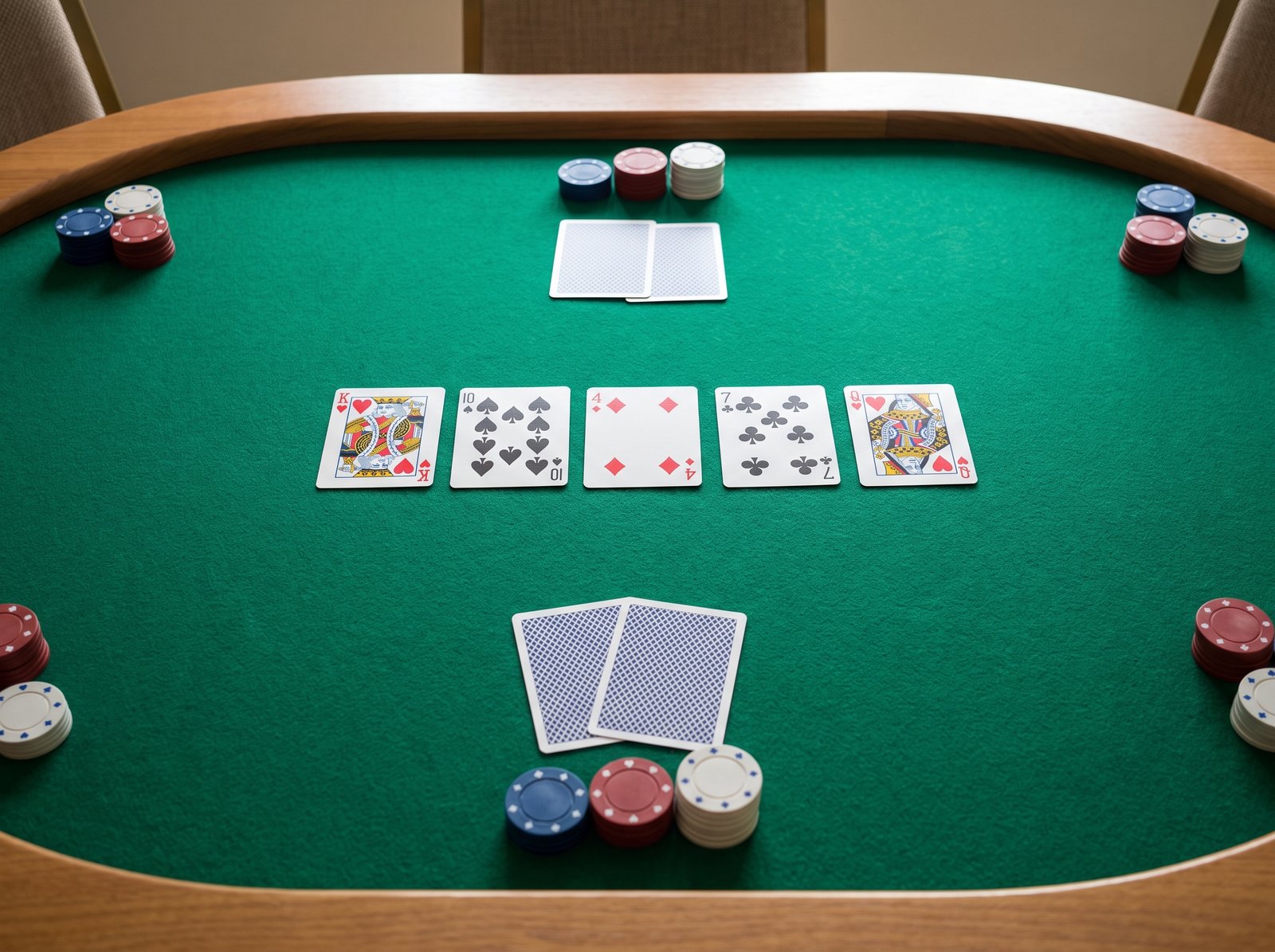
If you are searching for how to play poker for dummies, the easiest place to begin is Texas Hold’em. Each player receives two private cards, five shared cards can appear on the table, and your aim is to make the best five-card poker hand—or get every other player to fold before the final comparison.
Table of Contents
That sounds simple because the basic rules really are manageable. The confusing part for a new player is usually understanding when to bet, what the community cards mean, which poker hands beat others, and why your position at the table matters.
This guide explains all of those ideas without assuming you already know poker language. We will focus mainly on No-Limit Texas Hold’em, the form commonly meant when beginners talk about learning poker. Other poker games, such as Omaha, Seven Card Stud, and Five Card Draw, have different rules.
According to standard Texas Hold’em rules, each player receives two private hole cards. Up to five community cards are then dealt face up, and a player can use any combination of the available seven cards to make the strongest possible five-card hand. You can use both hole cards, one hole card, or even neither if the five community cards already make your best hand.
One more point is important before we begin: poker played for money is gambling. It should be treated as entertainment, not as a reliable method of earning income. In Great Britain, poker falls within gambling law, and most commercial gambling is restricted to people aged 18 or older. Rules in the United States vary by state, so players should check their local regulator before participating in real-money games.
How to Play Poker for Dummies in 9 Essential Steps
You do not need to memorize advanced mathematics before playing your first poker hand. Start by understanding these nine parts of Texas Hold’em.
Step 1: Understand the Main Goal of Poker
The basic goal is to win the pot.
The pot is the collection of chips that players have put into the middle during a hand. There are two main ways to win it.
The first is to reach the end of the hand, called the showdown, with the strongest five-card poker hand.
The second is to make everyone else fold before showdown. If all your opponents fold, you win the pot without needing to show that you had the best cards.
This second point is why poker is different from a simple card-ranking contest. You are making decisions while only seeing part of the information.
Suppose you have A♠ K♠. Those are strong starting cards, but they do not automatically win. The community cards, the actions of the other players, and later betting rounds can completely change the situation.
A beginner should therefore think of poker as a series of decisions rather than a game where you simply wait for good cards.
Step 2: Learn the Poker Hand Rankings Before You Play
Before you worry about bluffing or strategy, learn which hands beat which.
In standard Texas Hold’em, poker hands are compared using the best five cards available. The normal order from strongest to weakest is royal flush, straight flush, four of a kind, full house, flush, straight, three of a kind, two pair, one pair, and high card.
| Rank | Poker Hand | Simple Meaning |
|---|---|---|
| 1 | Royal Flush | A-K-Q-J-10, all the same suit |
| 2 | Straight Flush | Five consecutive cards of one suit |
| 3 | Four of a Kind | Four cards of the same rank |
| 4 | Full House | Three of one rank plus a pair |
| 5 | Flush | Five cards of the same suit |
| 6 | Straight | Five cards in sequence |
| 7 | Three of a Kind | Three cards of the same rank |
| 8 | Two Pair | Two different pairs |
| 9 | One Pair | Two cards of the same rank |
| 10 | High Card | No stronger combination |
For example, 9♠ 9♥ 9♦ K♣ K♥ is a full house because it contains three nines and two kings.
A♣ J♣ 8♣ 5♣ 2♣ is a flush because all five cards are clubs.
8♠ 7♥ 6♦ 5♣ 4♣ is a straight because the five cards appear in numerical order.
A pair of queens beats a pair of tens. A straight beats three of a kind. A flush beats a straight. A full house beats a flush.
If two players have hands from the same category, their individual card ranks normally decide the winner. For example, a pair of kings beats a pair of queens.
Sometimes a kicker decides the result. Imagine two players both make a pair of aces. One player’s best five-card hand is A-A-K-9-7 while the other has A-A-Q-9-7. The king kicker beats the queen kicker.
If both players’ best five cards are completely identical, the pot is normally split. Suits do not outrank one another in standard Texas Hold’em.
Step 3: Understand the Dealer Button, Small Blind and Big Blind
Texas Hold’em usually uses a dealer button and two forced bets known as the small blind and big blind.
The dealer button is a marker that moves around the table after each hand. It helps determine the order of play.
The player immediately to the left of the dealer button normally posts the small blind. The next player posts the big blind. These forced bets ensure there is something in the pot before players see their cards.
Imagine a friendly game where the blinds are 1 and 2 chips.
The small blind puts in 1 chip.
The big blind puts in 2 chips.
Everyone then receives two private cards.
Do not worry too much about the exact blind values while learning. What matters is understanding that the blinds create the starting pot and help determine where the betting action begins.
The button moves after each completed hand, so your position changes throughout the game.
This becomes important because acting later in a betting round usually gives you more information about what other players have decided to do.
Step 4: Receive Your Two Hole Cards and Play Pre-Flop
Once the blinds are posted, each player receives two face-down cards. These are your hole cards.
Only you should see them.
The first betting round is called pre-flop because it happens before any community cards have been placed on the table.
When action reaches you, your main choices will usually be:
Fold: Give up your cards and leave the current hand.
Call: Match the current bet.
Raise: Increase the current bet.
Under certain circumstances, you may also be able to check, although checking is not normally available pre-flop when there is an outstanding big blind or raise that you have not matched.
Suppose the blinds are 1/2 and nobody has raised.
If you want to continue from a normal position, you can call the 2-chip big blind, raise to a larger legal amount, or fold.
New players often believe folding means they have made a mistake. It does not. Folding is one of the most important decisions in poker.
You will normally fold many starting hands.
Consider a weak hand such as 8♣ 3♦. If several players are still to act after you, throwing it away is usually far more sensible than entering a pot simply because you want to see the flop.
By contrast, strong starting combinations such as A-A, K-K, Q-Q, A-K, and similar premium holdings deserve much more attention.
That does not mean strong cards always win. They simply give you a stronger starting point.
Step 5: Play the Flop
After the pre-flop betting round has finished, three community cards are dealt face up.
These first three shared cards are called the flop.
For example:
Your hole cards:
A♠ K♠
Flop:
A♦ 7♣ 2♥
At this point you have a pair of aces because your ace combines with the ace on the board.
Another round of betting follows.
After the flop, a player may sometimes check, which means taking no betting action while remaining in the hand. Checking is only available when nobody has made a bet that you need to match.
If someone bets before you, your normal choices become fold, call, or raise.
This is also the point where beginners should slow down and read the entire board.
Do not only look at your own cards.
Ask yourself what combinations the community cards make possible.
A flop of K♣ 8♦ 2♠ is relatively different from a flop of J♥ 10♥ 9♥.
The second board contains three connected cards of the same suit. Straights, flush draws, and other strong possibilities are therefore much more relevant.
You do not need advanced probability calculations yet. Simply get into the habit of looking at how the board interacts with your hand.
Step 6: Play the Turn
When flop betting is finished, a fourth community card is dealt.
This card is called the turn.
Another betting round follows.
Suppose you started with:
A♠ K♠
The flop was:
A♦ 7♣ 2♥
And the turn is:
K♦
You now have two pair: aces and kings.
But the turn can also make an opponent’s hand stronger, so never think only about how the new card helped you.
For example, imagine the board reads:
9♣ 8♣ 7♦ 6♥
Many straight combinations are now possible.
A player holding 10-9 can use 10-9-8-7-6 to make a straight.
A beginner mistake is becoming emotionally attached to the hand you had on the flop. Poker hands can change greatly when the turn and river appear.
Evaluate the board again every time a new community card is dealt.
Step 7: Play the River and Understand the Showdown
The fifth and final community card is called the river.
After the river is dealt, there is one final betting round.
If two or more players remain after that betting is complete, the hand reaches showdown.
The remaining players compare their best five-card combinations.
Remember: you are choosing the best five cards from the seven available cards—your two hole cards and the five community cards.
You do not have to use both hole cards.
For example:
Your cards:
A♣ 4♣
Board:
K♠ K♦ 10♥ 10♣ 8♠
Your best hand is K-K-10-10-A.
The ace from your hand acts as the kicker.
Now imagine another player holds:
Q♠ J♠
That player’s best hand is K-K-10-10-Q.
Your ace kicker is higher than the opponent’s queen kicker, so your five-card hand wins.
There are also situations where everyone’s best hand comes entirely from the board.
If the five community cards themselves make the strongest possible five-card combination for every remaining player, the pot can be divided.
Step 8: Learn What Check, Bet, Call, Raise, Fold and All-In Mean
The words used during betting can seem confusing at first, but there are only a few basic actions to learn.
A check means you remain in the hand without putting in additional chips. You can only check when you are not facing a bet.
A bet means you are the first player to put chips forward during that betting round.
A call means matching the current bet.
A raise means increasing the bet.
A fold means giving up the hand.
An all-in means betting all the chips you currently have available for that hand.
No-Limit Texas Hold’em allows a player to wager all of the chips in front of them when it is legal to bet or raise. However, detailed minimum-raise rules, all-in situations, side pots, and tournament procedures can become more complicated. Tournament venues may apply standardized procedures and house rules, so beginners should check the rules of the specific game before playing. The Poker Tournament Directors Association maintains rules intended to standardize tournament procedures.
A useful beginner habit is to make your action clear.
If you are playing live and want to raise, say “raise” before moving chips if you are unsure of the physical betting procedure.
Do not act before your turn.
Do not hide your large chips.
And do not expose your cards while other players are still making decisions.
These habits reduce confusion even when you are playing a casual home game.
Step 9: Use Simple Beginner Strategy Instead of Trying to Be Clever
Once you understand the rules, strategy becomes the next challenge.
The biggest improvement most beginners can make is surprisingly simple: play fewer weak hands.
You do not need to join every pot.
When your starting cards are poor, folding often saves you from difficult situations later in the hand.
You should also pay attention to position.
A player who acts near the end of a betting round has already seen what several opponents decided to do. That extra information can be valuable.
For example, imagine five players check before the action reaches you. That tells you something different from a situation where one player bets and another raises before your turn.
This is why the same starting hand may be easier to play from a later position than an earlier one.
Beginners should also be careful with bluffing.
Poker television clips often show dramatic bluffs because dramatic hands are entertaining. Real poker contains many ordinary folds, checks, calls, and value bets.
Do not think you need to bluff constantly to be a “real” poker player.
First learn how to recognize strong hands, understand the board, follow the action, and make clear decisions.
A Complete Example of One Texas Hold’em Hand
A full example makes the rules much easier to understand.
Imagine four players: Anna, Ben, Chris, and Dana.
The blinds are 1/2.
Anna has the dealer button.
Ben posts the 1-chip small blind.
Chris posts the 2-chip big blind.
Dana receives:
A♥ Q♥
Anna, Ben, and Chris also receive two private cards.
Pre-Flop
Dana acts first.
Because Dana likes the strength of A-Q, she raises to 6 chips.
Anna calls.
Ben folds.
Chris calls.
Three players remain.
The Flop
The dealer places three community cards on the table:
Q♣ 8♠ 3♥
Dana now has a pair of queens with an ace kicker.
Chris checks.
Dana bets.
Anna calls.
Chris folds.
Two players remain.
The Turn
The turn is:
A♦
Dana now has two pair: aces and queens.
Dana bets again.
Anna calls.
The River
The final card is:
5♣
Dana bets.
Anna calls.
They reach showdown.
Dana shows A♥ Q♥ for two pair, aces and queens.
Imagine Anna shows A♠ J♠.
Anna has one pair of aces.
Dana’s two pair beats Anna’s pair, so Dana wins the pot.
This is only a hypothetical learning example. It does not mean betting every time you make two pair is always correct. Real decisions depend on the board, bet sizes, opponents, stack sizes, and previous action.
The important lesson is how one hand moves through pre-flop, flop, turn, river, and showdown.
Why Position Matters So Much in Poker
Poker position means where you are sitting relative to the dealer button and the betting action.
Think of information as a small advantage.
If you must act before everyone else, you make your decision without knowing what those players will do.
If you act later, you get to see whether opponents check, bet, call, or raise before deciding.
For a beginner, you do not need to memorize every position name immediately.
Start by learning three broad groups.
Early position means you act relatively early.
Middle position means several players have already acted but others remain behind you.
Late position means you act near the end of the round.
The dealer button is an especially important late position in many post-flop situations.
As you improve, you can learn names such as under the gun, hijack, cutoff, button, small blind, and big blind.
At first, simply remember this rule of thumb: being later in the action generally gives you more information.
Common Poker Mistakes Beginners Should Avoid
Knowing what not to do can shorten the learning process considerably.
Playing Almost Every Starting Hand
Beginners often want to see every flop because folding feels boring.
The problem is that weak starting cards frequently create weak or difficult later decisions.
You are allowed to fold.
In fact, learning when not to continue is a fundamental part of poker.
Thinking One Pair Is Always a Great Hand
A pair can be good, but its value depends on the board and the action.
Imagine you hold A-A and the board eventually becomes:
9♥ 8♥ 7♥ 6♣ 5♠
Your pocket aces may have looked excellent before the flop, but the final board makes straights and other strong hands possible.
Always judge your cards in context.
Ignoring the Community Cards
Do not stare only at your two hole cards.
The board belongs to everyone.
If four hearts appear on the table and you do not have a heart, another player may have made a flush.
If the board contains 5-6-7-8, many straight possibilities exist.
Reading the board should become automatic.
Calling Just Because You Already Put Chips in the Pot
Chips you put into the pot earlier are no longer a reason to make another bad decision.
Suppose you called before the flop but the board becomes dangerous and an opponent shows strong action.
Do not think, “I already spent chips, so I have to stay.”
Every new decision should be based on the situation you face now.
Bluffing Too Often
Bluffing is a real part of poker, but beginners often overestimate its importance.
If an opponent is unlikely to fold, your bluff has little purpose.
Focus first on understanding hand strength and betting for clear reasons.
You can add more advanced bluffing concepts later.
Acting Out of Turn
Live poker follows an order.
Wait until the action reaches you.
Acting early can reveal information that other players should not yet have.
If you are unsure whether it is your turn, ask the dealer.
Chasing Losses
Losing one hand does not mean the next hand must recover the money.
Trying to immediately win back losses can lead to increasingly risky decisions.
GamCare specifically advises players not to chase lost money and recommends setting both money and time limits.
Poker Terms Every Beginner Should Know
You will understand games much faster once the common language becomes familiar.
Board: The community cards.
Hole cards: Your two private cards in Texas Hold’em.
Pot: The chips being contested.
Blind: A forced bet posted before the cards are dealt.
Flop: The first three community cards.
Turn: The fourth community card.
River: The fifth community card.
Showdown: The stage where remaining hands are compared after final betting.
Kicker: A side card that can break a tie between otherwise similar hands.
Stack: The chips a player has available.
Fold: Give up the current hand.
Call: Match the current bet.
Raise: Increase the current bet.
Check: Stay in without betting when no bet needs to be matched.
All-in: Put all available chips into the pot.
Pot odds: A comparison between what you must call and the size of the pot. This becomes useful when you begin studying poker mathematics.
Do not try to memorize every poker term in one day. The common words become much easier once you see them used in real hands.
Is Poker Mainly Luck or Skill?
Poker contains both chance and decision-making.
You cannot choose which cards are dealt. That part is random.
You can choose whether to fold, check, call, bet, or raise. Those decisions are where strategy enters the game.
Short-term results can be heavily affected by the cards. A correct decision can still lose a hand, while a poor decision can sometimes win.
For that reason, you should avoid thinking that learning a strategy guarantees profits.
For legal purposes, classifications can also differ by country. The UK Gambling Commission states that poker is treated as gambling and classified as a game of chance under the Gambling Act framework, even though players make strategic decisions.
The healthiest beginner goal is therefore to learn the rules and improve decision-making, not to expect poker to produce regular income.
How to Practise Poker Without Risking Much Money
You can learn most poker mechanics without immediately playing for meaningful stakes.
A home practice game can use chips with no cash value.
You can deal sample hands yourself and practise identifying the winning five-card combination.
You can also pause after every community card and ask:
What is my current hand?
What stronger hands are possible?
Which cards could change my hand?
What actions have the other players taken?
Practising this thinking process is more useful for a beginner than trying to copy advanced professional moves.
If you later choose to gamble for real money, use only legal and regulated services available where you live and set limits you can comfortably afford to lose.
In Great Britain, regulated online gambling operators must verify a customer’s age and identity before allowing them to gamble. The minimum legal age for most gambling, including casinos and online gambling, is 18.
In the United States, gambling regulation is state-specific rather than controlled by one simple nationwide online-poker rule. Check the relevant state gaming regulator rather than assuming a site is legal merely because you can access it.
A Simple Beginner Routine Before Every Decision
When action reaches you, try asking the same questions every time.
First, what do I have?
Identify your best current five-card hand.
Second, what does the board allow?
Look for possible pairs, straights, flushes, and stronger combinations.
Third, what happened before my turn?
A check, small bet, large bet, or raise gives you different information.
Fourth, where am I sitting?
Players still to act can change the situation.
Fifth, why am I choosing this action?
You should have a basic reason for betting, calling, raising, or folding.
You will not always reach the correct answer. Even experienced poker players face uncertain situations.
The purpose of this routine is simply to stop yourself from making random decisions.
Responsible Poker Play for Beginners
Poker should stay entertainment.
Never use rent money, bill money, borrowed money, emergency savings, or money needed for important responsibilities.
Set a spending limit before playing rather than deciding how much to spend after you begin losing.
A time limit can also help prevent sessions from continuing simply because you are frustrated or trying to recover losses.
Do not treat a loss as a debt that the game owes you.
The cards have no memory of what happened in the previous hand.
If poker begins affecting your finances, relationships, work, sleep, or mood, stopping is more important than learning another strategy.
For people in the UK, GamCare provides information and support through the National Gambling Helpline. In the United States, the National Council on Problem Gambling provides resources and access to the National Problem Gambling Helpline.
Frequently Asked Questions About How to Play Poker for Dummies
What is the easiest type of poker for a beginner to learn?
Texas Hold’em is a practical place to start because its basic structure is straightforward and beginner resources are widely available. Each player gets two private cards and can combine them with five community cards to make the best five-card hand.
How many cards do you get in Texas Hold’em?
You receive two private hole cards. Five community cards can eventually be dealt face up on the table.
The community cards appear as three cards on the flop, one on the turn, and one on the river.
Do I have to use both of my hole cards?
No.
In Texas Hold’em, your best five-card hand can use both hole cards, one hole card, or neither hole card. You simply use the strongest five-card combination available from your two private cards and the five community cards.
What is the best possible poker hand?
In standard Texas Hold’em hand rankings, a royal flush is the highest hand. It contains an ace, king, queen, jack, and ten of the same suit.
Can you win poker without having the best cards?
Yes.
If every other player folds, the last remaining player wins the pot without needing to reach a showdown.
This is one reason betting decisions are an important part of poker.
Is a flush better than a straight?
Yes.
Under standard Texas Hold’em hand rankings, a flush ranks above a straight but below a full house.
Should beginners bluff a lot?
No.
Bluffing is one tool, not the whole game. Beginners are usually better served by first learning starting-hand selection, board reading, position, hand rankings, and the basic betting process.
Can poker guarantee an income if I become good?
No.
Poker involves uncertain outcomes and the risk of losing money. Strategy can influence decisions, but it cannot guarantee profits. Real-money poker should not be treated as reliable income.
Conclusion: Learning Poker Is Easier One Hand at a Time
Learning how to play poker for dummies becomes much easier once you stop trying to understand everything at once.
Start with Texas Hold’em.
Memorize the basic hand rankings. Understand the dealer button and blinds. Learn the difference between pre-flop, flop, turn, and river. Know what check, call, bet, raise, fold, and all-in mean.
Then begin paying attention to position and the way community cards change the strength of your hand.
You do not need complicated bluffs or advanced mathematics for your first practice session.
Deal a few hands with chips that have no cash value, identify your best five cards after each street, and practise making decisions in the correct order. Once those basics feel natural, more advanced ideas such as pot odds, ranges, bet sizing, and tournament strategy will make far more sense.
If you later choose to play for money, check your local laws, use regulated services, set strict limits, and treat the game as entertainment rather than a way to make money.


Post Comment