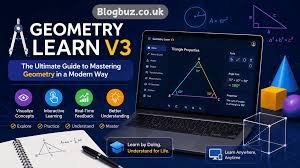
Geometry Learn V3 is a simple and friendly way to make geometry feel less confusing and more interesting.
For many students, Geometry Learn V3 starts as a subject filled with lines, corners, measurements, and formulas that may seem unrelated to real life.
At first, it can feel overwhelming and difficult to understand.
But once you slow down and learn the basics step by step, everything becomes clearer.
Geometry starts to feel like one of the most useful and visual parts of math.
It helps you practically understand the world around you.
You can see it in the shape of a window, the angle of a staircase, the design of a bridge, or the pattern of a floor tile.
That is exactly why Geometry Learn V3 matters.
It turns a difficult topic into something easier to follow, easier to remember, and easier to use in everyday situations.
The best part about geometry is that it is already around you. You do not need to imagine faraway problems or complicated equations before you can begin. You can look at a book, a table, a ball, a clock, or even a pizza slice and start identifying shapes and angles right away. Geometry Learn V3 works because it builds confidence from the ground up. Instead of rushing into advanced ideas, it helps learners understand the foundation first. That foundation includes points, lines, angles, shapes, symmetry, and measurement. When those ideas become clear, the rest of geometry becomes much easier to handle.
A big reason people struggle with geometry is not because the subject is impossible. It is because many lessons move too quickly. A learner may hear about angles before fully understanding lines. They may study triangles before truly knowing what makes a polygon. They may memorize formulas before learning why those formulas work. Geometry Learn V3 takes a better path. It encourages learners to notice, compare, draw, measure, and think. That slower and more natural style makes a huge difference, especially for beginners who need clear explanations and repeated practice.
Another reason this approach works well is that geometry is visual. Some students learn best by reading, but many learn better by seeing. Geometry gives you both. You can see shapes, trace their sides, mark their corners, and measure their parts. You can draw them by hand and check your understanding instantly. This makes geometry one of the most approachable areas of math once the learner knows how to start. Geometry Learn V3 helps make that start feel less intimidating and more rewarding.
Why Geometry Learn V3 Makes Geometry Easier to Understand
Geometry Learn V3 is helpful because it follows a natural learning process. It does not expect you to understand everything at once. Instead, it lets you move from simple ideas to more detailed ones in a smooth order. That matters because confidence grows when each step makes sense before the next one begins. A learner who understands basic lines and angles will find triangles easier. A learner who understands triangles will handle polygons more comfortably. A learner who understands polygons will feel less lost when circles, symmetry, or coordinate geometry appear later.
This method also supports long-term memory. When people learn by connecting ideas rather than just memorizing them, they remember more. For example, if you understand that a right angle looks like the corner of a book, you are more likely to recognize it later in a room, on a page, or in a building design. If you learn that a triangle always has three sides and three angles, that fact becomes easier to keep in mind when solving problems. Geometry Learn V3 focuses on that kind of understanding, which is far more useful than shallow memorization.
Another advantage is that geometry teaches practical thinking. It is not only about passing a test. It helps you estimate, compare, draw accurately, and make logical decisions. When you measure a shape or look for patterns in a figure, you are training your brain to pay attention to detail. That skill is useful in school, but it is also useful in art, design, construction, navigation, technology, and daily problem-solving. Geometry Learn V3 helps learners notice those connections, which makes the subject feel more meaningful.
The subject also becomes less stressful when examples are clear. A lot of confusion in geometry comes from abstract language. Words like ray, vertex, supplementary, congruent, or parallel may sound difficult at first. But when those words are linked to real objects and simple drawings, they become much easier to understand. A ray can be compared to a flashlight beam. A vertex can be shown as the point where two sides meet. Parallel lines can be seen in railroad tracks or the sides of a notebook. Geometry Learn V3 uses this kind of practical thinking to make the learning process smoother.
The Building Blocks Behind Shapes and Angles
Every geometry journey begins with the smallest pieces. Before you can understand a shape, you need to know what creates it. That is why points, lines, line segments, and rays are so important. A point represents a single exact location. It does not have size, thickness, or length. It is just a position. A line is a straight path that continues forever in both directions. A line segment is part of a line with two endpoints. A ray starts at one point and continues forever in one direction. These are the basic elements that support almost everything else in geometry.
Once these building blocks are clear, geometry becomes more logical. Shapes are made when lines connect. Angles appear when two rays or line segments meet at a point. Polygons are formed when several line segments close together. Circles are built around a center point with a constant distance from that center. Everything fits together in a clean structure, and that structure is one reason geometry feels elegant once you understand it. Geometry Learn V3 makes these connections easier to spot.
Think of it like learning to read music. You would not begin with a full symphony if you did not yet know the notes. In the same way, you should not jump into advanced geometry before understanding the parts that form a figure. When the learner starts with basic ideas, each new topic feels more familiar. The mind is no longer trying to solve a mystery. It is simply adding one piece at a time.
These early concepts are also useful because they appear in almost every geometry problem. A triangle begins with line segments. A polygon uses edges and vertices. A circle depends on a center and radius. Even more advanced topics like coordinate geometry and transformations still use the same foundational ideas. That is why strong basics matter so much. Geometry Learn V3 keeps attention on those basics long enough for the learner to truly absorb them.
Understanding Angles Without the Confusion
Angles are one of the first geometry topics that many students remember because they are so visible in daily life. An angle is formed when two lines, rays, or segments meet at a point. That meeting point is called the vertex. The space between the two sides tells you how wide the angle is. Some angles are sharp and small, while others are wide and open. Once you learn to recognize the difference, angles start to feel much easier.
The most common angle types are acute, right, obtuse, and straight. An acute angle is smaller than a right angle. A right angle measures exactly ninety degrees and often looks like the corner of a square or rectangle. An obtuse angle is larger than a right angle but smaller than a straight angle. A straight angle forms a straight line and measures one hundred eighty degrees. Each of these has a clear shape and purpose, and Geometry Learn V3 helps learners connect the measurement with the visual form.
Angles are easier to remember when tied to real examples. The opening of a door can show different angles. The hands of a clock can form many angle sizes depending on the time. The peak of a roof, the blade of scissors, and the corner of a book can all help students compare angles in a way that feels natural. This matters because geometry becomes easier when the learner starts seeing it in the real world rather than only on a worksheet.
There are also angle relationships that help solve problems more efficiently. Complementary angles add up to ninety degrees. Supplementary angles add up to one hundred eighty degrees. Vertical angles, formed when two lines cross, are equal. Adjacent angles sit next to each other. These ideas may sound technical, but they become much simpler when the learner sees diagrams and works through examples slowly. Geometry Learn V3 is valuable because it does not rush these relationships. It encourages understanding first, which leads to better accuracy later.
Shapes That Matter: From Triangles to Quadrilaterals
Once the basics are clear, shapes become the next exciting step. Shapes are everywhere, and many of them belong to the family of polygons. A polygon is a closed shape made from straight sides. Triangles are the simplest polygons because they have three sides and three angles. Quadrilaterals come next with four sides. After that, you can study pentagons, hexagons, octagons, and many other forms. Each shape has its own features, but they all follow the same general logic.
Triangles are especially important because they appear in so many places. A triangle is strong, stable, and easy to support. That is why it is so common in bridges, trusses, roofs, and design structures. It is also one of the easiest shapes to analyze because the sum of its interior angles always adds to one hundred eighty degrees. Once that rule becomes familiar, triangle problems become much more manageable. Geometry Learn V3 helps that rule feel less like a trick and more like a useful pattern.
There are several types of triangles. Some have equal sides, some have equal angles, and some have a right angle. Knowing these differences helps you identify the shape quickly and solve problems correctly. A learner who sees a triangle and understands its type can usually work with it more confidently than someone who only memorized the label. That is why good geometry learning should always combine naming, drawing, and measuring.
Quadrilaterals are another major group worth studying carefully. Squares, rectangles, parallelograms, rhombuses, and trapezoids all belong here. Each one has different rules, and those rules help you compare shapes without guessing. A square has all equal sides and all right angles. A rectangle has right angles and opposite sides that match. A parallelogram has opposite sides that are parallel. A rhombus has all equal sides. A trapezoid has one pair of parallel sides. Geometry Learn V3 turns those facts into meaningful visual ideas instead of dry memorization.
Circles, Curves, and the Beauty of Round Shapes
Not every shape is built from straight lines. Circles give geometry a softer, smoother side. A circle is a set of points that are all the same distance from a center point. That constant distance is the radius. The full distance across the circle through the center is the diameter. These ideas may seem simple, but they are very powerful because they explain how circular objects are measured and understood.
Circles are useful because they show up in many real-life places. Wheels, clocks, coins, plates, lids, and many types of sports equipment use circular design because circles roll smoothly and distribute force evenly. In nature, you can also find round forms in drops of water, tree rings, and the shape of some fruits and seeds. Geometry Learn V3 becomes especially interesting at this stage because circles connect the abstract world of math with the real world of design and movement.
Circles also teach learners about angle measurement in a new way. A full circle contains three hundred sixty degrees. Half of a circle equals one hundred eighty degrees, which matches a straight angle. A quarter of a circle equals ninety degrees, which matches a right angle. This makes circles especially helpful for understanding direction, rotation, and symmetry. Once students see these connections, they begin to understand why circle-based geometry is so important in art, engineering, navigation, and technology.
Curved shapes also make geometry more visually interesting. Many learners find straight-sided figures easier at first, but curved shapes often become memorable because they feel familiar. They remind us of motion, flow, and balance. By including circles and related ideas, Geometry Learn V3 gives learners a fuller picture of geometry rather than a narrow one. That wider understanding helps learners feel more prepared for advanced study later on.
How Geometry Shows Up in Everyday Life
One of the strongest reasons to learn geometry is that it is useful outside the classroom. Geometry is not locked inside a textbook. It is part of buildings, roads, furniture, packaging, sports, and digital design. When you look at a house, you see angles in the roof, rectangles in the windows, and lines in the walls. When you look at a floor, you may see repeating shapes or patterns. When you use a phone, you are seeing geometry in the screen layout, the icons, the camera framing, and the way the device is designed to fit the hand.
Architecture is one of the clearest examples of geometry in action. Builders and designers rely on angles, shapes, and measurements to make sure structures are balanced and strong. A bridge must hold weight safely. A stairway must rise at the correct angle. A building must maintain symmetry and alignment. Even a simple shelf or table depends on accurate measurements. Geometry Learn V3 helps learners understand that geometry is not just a school subject. It is a practical language used by the world around us.
Art and design also depend heavily on geometry. Artists use symmetry, proportion, perspective, and shape placement to create pleasing visuals. Graphic designers use grids, spacing, and alignment to make content easy to read and attractive to the eye. Game developers and animators build worlds using shapes, angles, and movement paths. Even photography depends on geometry through framing and composition. Once learners see these links, they often become more interested in the subject because they can finally understand how it connects to creativity.
Sports, navigation, and science also rely on geometric thinking. The path of a ball, the direction of a pass, the angle of a shot, and the layout of a field all involve geometry. Maps use scale and direction. Science uses measurement and shape analysis. Technology uses geometry in sensors, modeling, and visual systems. Geometry Learn V3 is powerful because it teaches learners to notice these patterns everywhere. That awareness makes the subject feel practical and alive.
Smart Ways to Study Geometry and Remember It Better
Studying geometry becomes easier when you use methods that fit the subject. Because geometry is visual, drawing is one of the best ways to learn it. When you sketch points, lines, shapes, and angles by hand, you give your brain more than just words. You create a picture it can remember. Even simple practice sketches can make a huge difference because they force you to look carefully at form and structure.
Measuring is another helpful habit. When you use a ruler or protractor, you begin to understand how shapes work in a more precise way. Measurements remove guesswork and help you see the difference between what looks right and what is actually correct. This is important because geometry often asks for careful observation. A shape may seem equal at a glance, but the actual sides or angles may tell a different story. Geometry Learn V3 encourages careful checking, which is exactly what strong geometry learning requires.
A good strategy is to move from simple to complex. Start with identifying shape types. Then study their properties. After that, practice measuring sides and angles. Finally, solve mixed problems where you have to combine several ideas. This gradual approach makes the subject feel less overwhelming. Each step prepares you for the next. When learners try to skip ahead too quickly, confusion grows. When they build steadily, confidence grows too.
It also helps to talk through the logic out loud or explain it to someone else. Teaching is one of the best ways to learn because it forces you to organize your thoughts. If you can describe why a triangle has three sides or why a right angle matters, you are not just repeating information. You are understanding it. Geometry Learn V3 works well for that reason. It supports real understanding, not just temporary memory.
Common Mistakes That Make Geometry Harder Than It Needs to Be
Many learners struggle with geometry because of a few common mistakes. One mistake is assuming that a picture always tells the full truth. In geometry, drawings are often not perfectly to scale unless the problem clearly says so. That means you should not guess based only on appearance. You should use the given measurements and properties. Geometry Learn V3 helps correct this habit by encouraging careful reading and logical thinking.
Another mistake is mixing up shape names or properties. For example, a square and a rectangle are similar, but they are not identical. A triangle and a polygon are related, but one is more specific than the other. A learner who does not pay attention to the exact definition can easily lose points on simple questions. The solution is to study the features one by one and compare them directly. Strong geometry learning depends on precision.
A third mistake is forgetting the rules that connect angles and shapes. Triangle angle sums, complementary angles, supplementary angles, and parallel line relationships are all important. When students forget these patterns, they often spend extra time trying to solve problems that could have been simpler. Reviewing those rules regularly helps keep them fresh. Geometry Learn V3 is designed to strengthen that kind of steady review.
A fourth common issue is rushing. Geometry rewards patience. It asks you to observe, measure, compare, and check. When you move too quickly, small details get missed. A single wrong label or small measurement error can change an entire answer. That is why a calm approach usually works better than a hurried one. Careful learners often do better because geometry is built on attention and logic, not speed alone.
Why This Approach Helps Beginners and Students at Every Level
Geometry Learn V3 is useful not only for beginners but also for students who already know some geometry and want a clearer way to strengthen their skills. Beginners benefit because the material feels less overwhelming. They can build from the ground up without getting lost. But more experienced learners also benefit because reviewing the basics often reveals gaps that were missed earlier. A strong foundation is valuable at every level.
This approach is especially helpful for students who feel nervous about math. Geometry can seem scary when it is presented as a long list of rules and formulas. But when it is taught through shapes, real-life examples, and simple explanations, the fear starts to fade. The learner begins to see that geometry is not random. It follows patterns. Once patterns become visible, confidence grows. Geometry Learn V3 supports that confidence-building process.
It also helps students who want to improve test performance. Many geometry exam questions are not hard because the ideas are advanced. They are hard because students do not recognize the relationships quickly enough. A learner who understands the basics can solve questions more efficiently and with less stress. That is why foundational learning often leads to better scores. It reduces confusion and improves accuracy.
Beyond school, this method helps learners become better thinkers. Geometry sharpens the ability to analyze, compare, and reason clearly. Those are skills that matter in many areas of life. Whether someone wants to study science, design, architecture, engineering, or computer graphics, geometry creates a strong base. Geometry Learn V3 is valuable because it helps that foundation grow in a simple, practical way.
The Real Value of Learning Geometry the Easy Way
The real value of geometry is not just knowing the names of shapes. It is learning how to see structure, order, and measurement in the world around you. That is what makes geometry such an important subject. Once you understand it, you begin to notice patterns that were always there but may have gone unseen before. A staircase becomes a set of angles. A tile floor becomes a pattern of repeated shapes. A building becomes a balance of lines, corners, and support.
Geometry Learn V3 is a useful way to reach that level of understanding because it respects the learner’s pace. It does not treat geometry like a race. It treats it like a skill that gets stronger with practice. That is a much healthier and more effective way to study. When learners are given a clear path, they are far more likely to stay interested and feel successful. That matters because confidence often decides whether someone keeps learning or gives up too early.
The subject also becomes more enjoyable when the learner starts seeing progress. A difficult shape becomes readable. A confusing angle becomes recognizable. A formula begins to make sense. Those small wins build momentum. Over time, that momentum turns into real understanding. Geometry stops being a problem and becomes a tool. That shift is one of the biggest benefits of learning it well.
If your goal is to understand shapes and angles without feeling overwhelmed, then Geometry Learn V3 offers the kind of learning style that makes progress possible. It keeps the ideas simple, the steps clear, and the examples useful. It gives beginners a path forward and helps more advanced learners sharpen their basics. That combination is powerful.
Final Thoughts on Geometry Learn V3
Geometry Learn V3 is more than just a phrase or a topic. It represents a smart, easy, and practical way to learn one of the most important parts of math. By starting with points, lines, angles, and basic shapes, then moving toward circles, polygons, and real-life examples, learners can build a strong understanding without unnecessary stress. The journey becomes easier when each step makes sense and every concept connects to something visible.
This is why geometry should not be treated as something distant or impossible. It is all around you, and it becomes more interesting the more you notice it. The corners of a room, the symmetry of a design, the path of a ball, and the shape of a bridge all tell the same story: geometry is part of everyday life. Geometry Learn V3 helps that story become clearer, more useful, and more enjoyable to read.
If you are ready to improve your understanding of shapes and angles, keep practicing, keep observing, and keep connecting each idea to real examples. The more you work with geometry, the more natural it becomes. And once it becomes natural, it becomes useful for school, for problem-solving, and for seeing the world with sharper eyes.


Post Comment