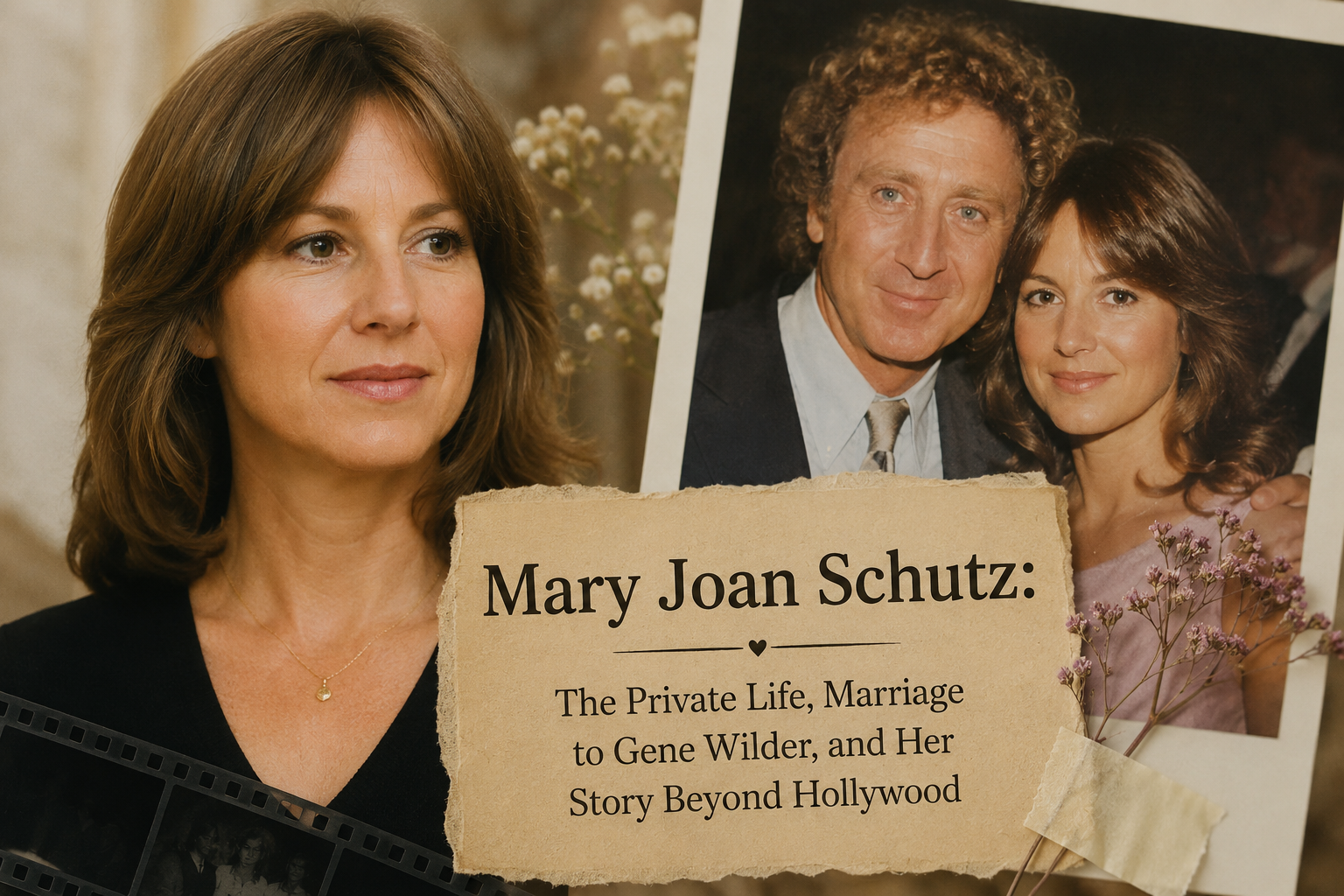
Mary Joan Schutz is one of those names that keeps resurfacing whenever people revisit Gene Wilder’s life, yet she remains far less documented than the famous actor she once married. That contrast is exactly what makes her story so interesting. She was not a Hollywood star chasing headlines, and she did not build a public identity around celebrity culture. Instead, her name became part of film-history conversations because of one important chapter: her marriage to Wilder, the adoption of her daughter, and the quiet way her life stayed mostly outside the spotlight. Wilder, of course, became globally known for roles in The Producers, Willy Wonka & the Chocolate Factory, and Frankenstein, but the woman who shared a major stretch.
Mary Joan Schutz: The Private Life Behind Gene Wilder’s Fame
The public record around Mary Joan Schutz is limited, and that scarcity is part of her story. When a person becomes known mainly through a famous spouse, it can be tempting to reduce them to a footnote. But Mary Joan Schutz deserves a closer look because the little that is verifiable reveals a meaningful place in Gene Wilder’s personal history. She entered his life after his first marriage ended, married him in 1967, and became the mother figure to the daughter he later adopted. Biographical summaries of Wilder consistently place Mary Joan Schutz in his family timeline, even though her own life was never shaped by the entertainment industry in the way his was.
What stands out most about Mary Joan Schutz is not a long list of public appearances or interviews, but the absence of them. In an era when many celebrity partners are pulled into the orbit of fame, her story remains unusually understated. That silence does not mean her role was unimportant. On the contrary, it suggests a life that was lived with privacy, dignity, and distance from the machine of Hollywood publicity. For readers searching for “mary joan schutz,” that quietness is often surprising, but it is also what makes her story compelling: she matters precisely because she did not turn herself into a public brand.
Understanding Mary Joan Schutz also means understanding the personal world Gene Wilder was building at the time. Wilder had already begun shaping the career that would make him unforgettable to audiences, and his life was moving from stage work and early screen roles into the cultural spotlight. In other words, Mary Joan Schutz did not simply appear beside an unknown actor; she became part of a life that was already gathering public attention. That combination of private family life and growing fame is often where celebrity marriages feel the most pressure, and it helps explain why her story continues to attract curiosity decades later.
Gene Wilder’s fame matters here because it explains why Mary Joan Schutz is still discussed at all. Wilder was born Jerome Silberman, later became known as Gene Wilder, and built a career that included stage work, acclaimed film roles, writing, and later television appearances. Britannica lists Mary Joan Schutz among his spouses, and Biography notes that he married her in 1967 and adopted her daughter Katharine. Those basic facts are the backbone of her public story. Everything beyond them belongs to the broader emotional history of one family rather than the public timeline of a celebrity.
How Mary Joan Schutz Came Into Gene Wilder’s Life
The most commonly repeated account is that Mary Joan Schutz and Gene Wilder met through his sister. That detail matters because it frames their relationship as something personal and family-centered rather than a typical Hollywood romance built through film sets, agents, or publicity events. It suggests trust, familiarity, and a sense of connection that began before the weight of celebrity fully settled around Wilder. In a life story dominated by performances, awards, and roles, the origin of their relationship feels almost modest—and that modesty fits Mary Joan Schutz’s overall presence in the record.
By the time they married in 1967, Wilder was no stranger to professional ambition. He had already made his screen debut and was working toward the roles that would define his legacy. Britannica and Biography both confirm the marriage to Mary Joan Schutz, and Biography specifically notes that Wilder adopted her daughter Katharine after the marriage. That detail is essential because it shows this relationship was not only romantic; it became a family decision with real emotional stakes. Mary Joan Schutz was not just a spouse entering Wilder’s orbit. She was a mother whose child became legally connected to Wilder as well.
For many readers, the adoption is the most human part of the story. It shows that the relationship was built around more than publicity or convenience. Wilder reportedly adopted Katharine because he felt it was the right thing to do after she began calling him “Dad,” a detail that appears in biographical accounts of his life. That moment says a great deal about the household Mary Joan Schutz was helping shape. It also shows that her life cannot be separated from the emotional choices made within the family. She was not simply “Gene Wilder’s wife.” She was the mother in a blended family that briefly became a permanent legal unit.
The marriage also belongs to a crucial phase in Wilder’s career. The late 1960s and early 1970s were years in which he moved from promising actor to cultural icon. Films like The Producers and Willy Wonka & the Chocolate Factory changed how audiences saw him, and later collaborations with Mel Brooks made him even more beloved. That rise in visibility would have affected any family life around him. For Mary Joan Schutz, that meant the private world of home life existed beside a public life that was becoming increasingly impossible to ignore.
Marriage, Motherhood, and the Reality of a Life Near Fame
It is easy to imagine Hollywood marriages as glamorous from the outside, but the reality is usually much more complicated. Mary Joan Schutz’s marriage to Gene Wilder appears to have involved love, family responsibility, and the challenge of living close to a man whose career was accelerating rapidly. The facts available to the public are sparse, but the basic outline is clear: they married in 1967, Wilder became the adoptive father of Katharine, and the relationship later ended. That progression alone suggests a real domestic life, not merely a celebrity headline.
The presence of Katharine made the marriage especially significant. Once Wilder adopted her, the relationship moved beyond adult partnership into parenthood. Biographical summaries of Wilder note that he later became estranged from Katharine after the split, which indicates that the breakup affected more than just the couple themselves. Families do not disappear cleanly when marriages end, and blended families often carry emotional consequences long after the legal part is over. Mary Joan Schutz’s story therefore connects to broader themes of motherhood, trust, and the vulnerability that comes with building a family inside a public life.
This is also where the “private life” part of her story becomes more than a phrase. Mary Joan Schutz did not leave behind a widely known career or a flood of interviews to anchor her identity in public memory. Instead, she is remembered through a relationship that became deeply personal and then complicated. That does not make her story less valuable. It actually makes it more relatable. Many people live lives that are meaningful in the home, within relationships, and through parenting—without ever wanting public attention. Her biography reflects that quieter form of importance.
There is also something instructive about how little is securely known about her beyond the marriage. In a celebrity culture that often turns spouses into content, Mary Joan Schutz remains elusive. That suggests a deliberate distance from publicity, or at least a life that was not built for public consumption. For a blog reader, that can be refreshing. It allows the article to focus less on gossip and more on the real human pattern that emerges: a woman formed a family, lived beside a major entertainer, and then stepped away from the spotlight as the marriage ended.
Why the End of the Marriage Still Gets Attention
Any discussion of Mary Joan Schutz eventually reaches the end of the marriage, because that is the point where public interest in her story intensifies. Different biographical sources describe the length of the marriage slightly differently, but they agree on the central fact that the union did not last. Britannica lists Mary Joan Schutz as one of Wilder’s spouses from 1967 to 1980, while Biography says he married her in 1967 and later split from her, after which he became estranged from Katharine. The differences in how sources frame the timeline are a reminder that celebrity biographies often compress complicated personal histories into simplified summaries.
What matters most is not the exact calendar detail, but the emotional arc. A marriage that begins with family connection and adoption does not end casually. It leaves behind memories, responsibilities, and often unresolved feelings. The fact that Wilder later wrote about love, psychotherapy, and personal struggle in his memoir Kiss Me Like a Stranger shows how deeply his relationships shaped him. Mary Joan Schutz belongs to that story, even if she never publicly authored her side of it. Her place in his life matters because it influenced his path as a husband and father long before later marriages brought different chapters.
Some accounts have connected the breakup to suspicion and personal strain, but those details are less firmly documented across the most reliable sources, so they should be treated carefully. What can be said with confidence is that the relationship ended, Wilder eventually remarried, and the family structure changed in ways that left a lasting mark. For readers, that is often enough to understand why Mary Joan Schutz remains a subject of interest: she represents one of the most important private turning points in Gene Wilder’s life.
There is also a broader reason the end of the marriage still draws attention. People are drawn to stories where public success and private loss intersect. Wilder became a beloved screen presence, yet his personal relationships were more complicated than the warm image audiences often remember. Mary Joan Schutz sits inside that tension. She is part of the reason his personal biography feels more human than idealized. Her story reminds us that fame does not erase emotional complexity; it often magnifies it.
Mary Joan Schutz Beyond Hollywood
The phrase “beyond Hollywood” may be the best way to understand Mary Joan Schutz. Unlike many people connected to stars, she did not appear to use the association as a springboard to media visibility. Instead, she seems to have kept her life in the background. That makes her a rare figure in celebrity history: someone who became famous by proximity yet did not appear to chase fame for herself. The result is a public image defined by restraint.
This quietness invites a different kind of admiration. It is easy to admire fame, but it is harder to admire someone who has chosen not to perform their life for the camera. Mary Joan Schutz’s story suggests that privacy itself can be a meaningful life choice. In a world where people are often rewarded for exposure, her low profile feels almost radical. The lack of spectacle around her is not a gap to be filled; it is part of her identity.
Her story also points to a truth that often gets lost in celebrity coverage: the people around stars have their own inner lives, even when the public never sees them. Mary Joan Schutz was a mother, a partner, and a central part of a family structure during a crucial period of Gene Wilder’s life. Those roles matter whether or not they were documented in magazines or TV interviews. A private life is still a life, and in many ways it can be the more honest one because it is not shaped for consumption.
That is why articles about Mary Joan Schutz continue to resonate. Readers are not only looking for facts; they are looking for a fuller picture of a famous man’s life, and she is part of that picture. She helps explain who Wilder was offscreen, how he built a family, and how his personal decisions echoed across later years. Even though she stayed outside Hollywood’s main stage, she remained central to one of its quieter human stories.
What Her Story Says About Gene Wilder’s Personal Life
Mary Joan Schutz also helps illuminate Gene Wilder himself. When people think of him, they often remember his comic brilliance, his expressive face, and his unforgettable performances. Yet his personal life reveals a very different layer: a man who married four times, adopted a child, experienced estrangement, loved again, and eventually wrote about his search for love in memoir form. Britannica and Biography both show that Mary Joan Schutz was a significant part of that longer emotional journey, not just a brief stop along the way.
His later marriages to Gilda Radner and Karen Boyer often dominate the discussion of his private life, but Mary Joan Schutz belongs at the center of the timeline because she was there during a formative period. She was part of the years when he was establishing the artistic identity that audiences now celebrate. The adoption of Katharine further deepened the connection between personal and professional life, because it made Wilder not only a husband but also a father. That aspect of his story is impossible to separate from Mary Joan Schutz’s own place in it.
There is another layer here too: Wilder’s later reflections on love and therapy suggest that relationships were never simple for him. The fact that he eventually wrote a memoir about love and art tells us that he saw his emotional life as something worth examining. Mary Joan Schutz was part of the chapter that likely shaped those reflections. Even when she is not named in the memoir’s title, her role in his life is still part of the emotional architecture behind his later self-understanding.
For readers researching “mary joan schutz,” this is the key takeaway: her importance lies not in celebrity behavior, but in the way she intersects with one of Hollywood’s most beloved figures during a deeply personal phase. That is enough to make her worthy of attention. In fact, the very absence of sensational details makes her story more credible and more respectful. She is not a tabloid figure. She is a real person whose private life briefly became part of Hollywood history.
Frequently Asked Questions About Mary Joan Schutz
People often ask who Mary Joan Schutz really was, and the most accurate answer is simple: she was Gene Wilder’s second wife and the mother of the daughter he adopted. Beyond that, the public record is modest. Reliable biographical sources focus mainly on her connection to Wilder, which is why she is so often described through the lens of that relationship rather than through a separate public career. That does not make her less important; it just means her life was private.
Another common question is whether Mary Joan Schutz had children with Gene Wilder. The best-supported answer is that Wilder adopted her daughter Katharine after the marriage, and that Katharine later became estranged from him after the split. That detail appears consistently in biographical summaries of Wilder’s life and is one of the most important facts linked to Mary Joan Schutz’s name. It shows that her story is inseparable from the family life she shared with him.
A third question is why Mary Joan Schutz is still searched online today. The answer is that people remain fascinated by the private lives of famous artists, especially when those lives include adoption, marriage, separation, and emotional complexity. Because Gene Wilder remains a beloved cultural figure, the women in his life continue to attract attention. Mary Joan Schutz stands out because she stayed mostly out of the spotlight, which makes her all the more intriguing to modern readers.
Final Thoughts on Mary Joan Schutz
Mary Joan Schutz may never have sought fame, but her story still matters because it reveals the human side of a larger cultural legend. She was there at an important time in Gene Wilder’s life, became part of his family, helped shape a home around a child he adopted, and then moved back into privacy after the marriage ended. That is not a small story. It is a deeply human one. In a culture that often prizes visibility over substance, Mary Joan Schutz reminds us that the quiet chapters are sometimes the most meaningful.
If you enjoyed reading about Mary Joan Schutz, bookmark this article, share it with readers who love classic Hollywood history, and keep exploring the hidden personal stories behind the stars. The people closest to fame often reveal the most about it, and Mary Joan Schutz is a perfect example of how a private life can still leave a lasting mark.


Post Comment