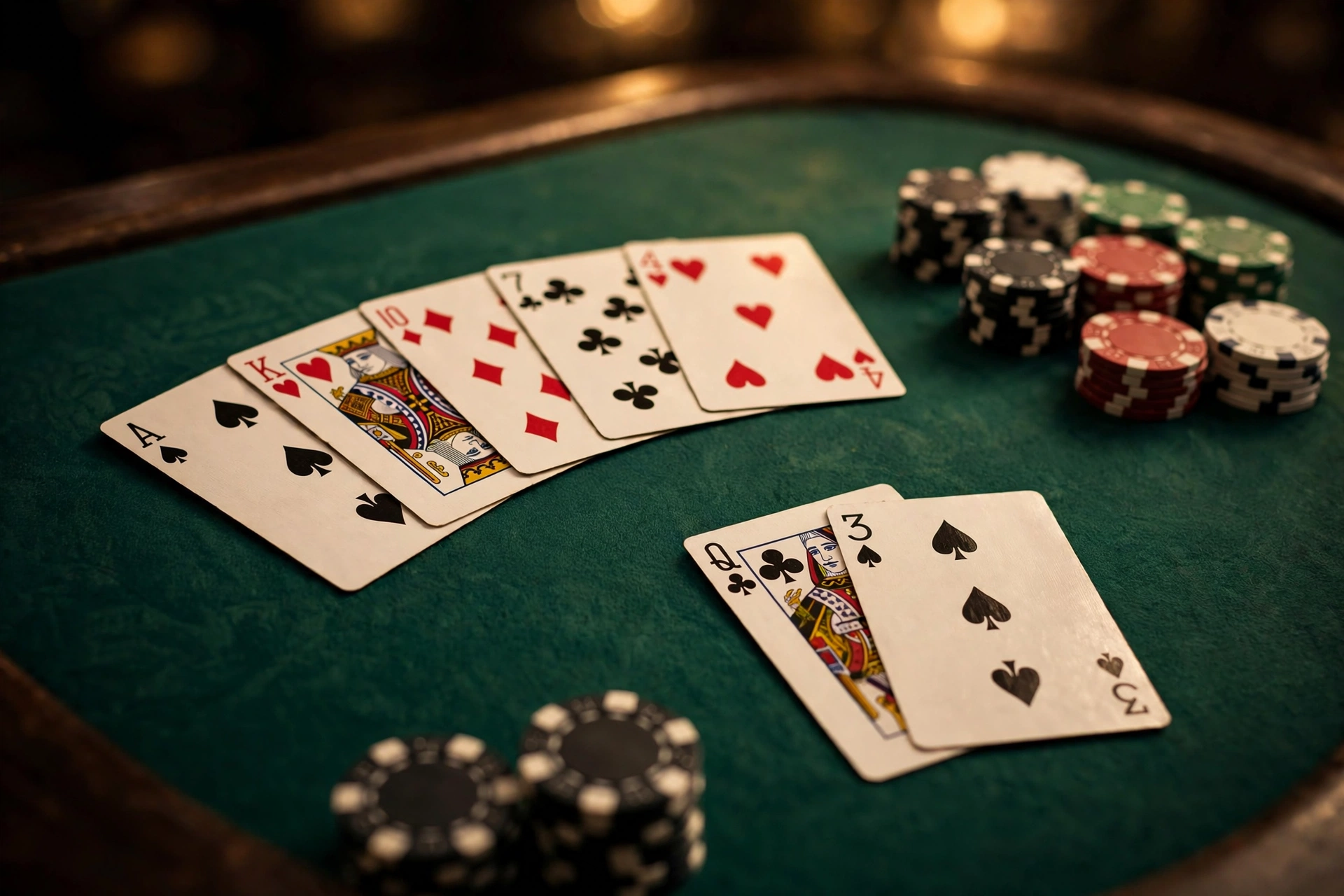
If you want to learn how to play pai gow poker for beginners, start here: you get seven cards, you split them into a five-card hand and a two-card hand, and you win only if both of your hands beat the dealer’s matching hands. That’s the whole game. The first time I sat down at a pai gow table, a friendly dealer set my hands for me while the regulars nodded along like it was the most natural thing in the world — and within twenty minutes I understood why people call this the friendliest table in the casino.
Pai gow poker is the slowest table game on most casino floors, and I mean that as a compliment. Where blackjack forces a decision on you every thirty seconds, pai gow gives you time to breathe, chat with your neighbors, and actually think about your cards. Most hands end in a push — nobody wins, nobody loses, your bet just stays where it is — which means your money lasts a remarkably long time. For a beginner, that is gold: you get hours of entertainment and practice for a fraction of what a blackjack session would cost.
Table of Contents
What Pai Gow Poker Actually Is
Pai gow poker was invented in the mid-1980s by a California card-room owner who wanted to bring the ancient Chinese domino game of pai gow to American poker players. The idea stuck. Today you’ll find it in almost every brick-and-mortar casino in the United States, and plenty of online casinos deal it too.
The game uses a standard 52-card deck plus one joker, making 53 cards. Up to six players can sit at the table, but here’s the lovely part: you’re not playing against the other players at all. Everyone is playing only against the dealer, and the dealer follows a fixed set of rules called the “house way,” with zero personal discretion. That means no bluffing, no reading opponents, and no pressure to make lightning-fast decisions. It’s just you, your seven cards, and a puzzle to solve.
If you’ve already tried other beginner-friendly card games, you might enjoy our guide on how to play baccarat for beginners too — it shares pai gow’s relaxed, low-pressure vibe.
The Goal: Two Hands, Both Better Than the Dealer’s
After everyone places their bet, the dealer deals seven cards face down to each player and to themselves. Your job is to arrange those seven cards into two hands:
- A five-card “high” hand (also called the back hand), ranked with normal poker hand rankings
- A two-card “low” hand (also called the front hand), which can only be a pair or two unpaired cards
There is one iron rule: your five-card hand must rank higher than your two-card hand. If you break this rule — say, you put a pair of kings up front and ace-high in the back — your hand is “fouled” and you lose automatically. The dealer will usually catch it and help you fix it before the showdown, but don’t count on it.
Once everyone sets their hands, the dealer reveals their cards, set according to the house way, and compares hand against hand: your high hand versus the dealer’s high hand, your low hand versus the dealer’s low hand.
- Win both hands: you win even money, minus a 5% commission to the house
- Win one, lose one: a push — your bet is returned, no harm done
- Lose both hands: you lose your bet
- Tie a hand: the dealer wins ties. This is called the “copy” rule, and it’s one of the small edges that keeps the casino’s lights on.
Because pushes are so common — roughly four in ten hands — the game moves slowly and your bankroll stretches. That is the entire appeal.
How the Joker Works (It’s Not Fully Wild)
The joker in pai gow poker is a “bug,” not a true wild card. It can only be used in three ways:
- As an ace
- To complete a straight
- To complete a flush (or straight flush)
That’s it. You can’t use the joker as, say, a king to make three kings unless it’s completing a straight or a flush. In your two-card low hand, the joker always counts as an ace, which makes ace-joker the best possible low hand you can hold.
When I first learned this, I tried to use the joker as a third queen and the dealer gently corrected me. Learn from my embarrassment: the joker has strict limits.
How a Round Plays Out, Step by Step
Let me walk you through a typical hand so you can picture it:
- Place your bet in the betting circle before any cards are dealt.
- Receive seven cards face down. Don’t show them to anyone.
- Set your hands. Take your time — this is the skill part. Separate the cards into a five-card hand and a two-card hand, remembering the five-card hand must be stronger.
- Place your hands face down in the designated areas — high hand toward the back, low hand toward the front.
- The dealer reveals their seven cards and sets them by the house way.
- Hands are compared. The dealer turns your cards over, compares each hand against the dealer’s, and settles your bet: a win (minus the 5% commission), a push, or a loss.
The 5% commission is usually collected when you win, sometimes rounded up to the nearest dollar or tracked and collected at the end of your session. Some casinos offer “commission-free” pai gow with slightly adjusted rules instead — if you see that option, read the fine print, because the trade-off is usually a rule that favors the house in specific situations, like a dealer queen-high triggering a push instead of a win.
The House Way: Why the Dealer Has No Choices
Every casino posts its “house way” — the exact recipe the dealer must follow when setting hands. It removes all judgment from the dealer’s side, which is wonderful for beginners because it means the dealer is never outplaying you. They’re following a script.
The house way varies slightly between casinos, but the principles are consistent. And here’s the beginner’s secret weapon: you can ask the dealer to set your hand the house way too. Most tables allow this, and dealers are happy to do it. When I was starting out, I asked for house-way help for my first dozen hands and nobody batted an eye. There’s no shame in it — even experienced players do it when they’re tired or unsure.
Beginner Strategy: How to Set Your Hands
Hand-setting is the whole skill of the game. A few simple rules cover the vast majority of situations:
No pair, no straight, no flush: Put your highest card in the five-card hand and your second-highest card in the two-card hand, with everything else in the five-card hand. This keeps the back hand legally stronger than the front.
One pair: Keep the pair together in the five-card hand and put your two highest remaining cards in the two-card hand. A pair in back plus two high cards up front is simple, legal, and close to optimal.
Two pair: Split them — the higher pair goes in the five-card hand and the lower pair goes in the two-card hand, with your remaining three cards joining the five-card hand. (The five-card hand must outrank the two-card hand, so the bigger pair always goes in back.)
Three of a kind: Keep all three together in the five-card hand. The one famous exception: three aces. With three aces, most players split them — a pair of aces in back, one ace up front — because ace-high is such a strong low hand.
Straight or flush: Generally keep it together in the five-card hand. Breaking up a made straight or flush is rarely worth it unless doing so dramatically improves your low hand.
Full house: Split it — the pair goes up front, three of a kind stays in back. Trips in back versus a pair in front is a powerhouse setup.
Four of a kind or better: Congratulations — this barely ever happens. Keep quads together in back (unless they’re jacks or higher, where some players split, but as a beginner just keep them together and enjoy it).
When in doubt, ask the dealer. Seriously. They’d rather help you set a hand correctly than deal with a fouled one.
The 5% Commission and the Banking Option
That 5% commission on wins is how the house makes its money, and it brings the house edge to around 2.5–2.7% with decent play — higher than blackjack played well, but the slow pace more than compensates in entertainment value per dollar.
Some casinos let you bank — act as the banker for a hand, usually every other hand, which flips the copy rule in your favor (you win the ties). Banking cuts the house edge significantly, sometimes below 1%. If your casino offers it and you have the bankroll for it, take the bank whenever it’s offered. Just know you’ll need enough chips to cover the other players’ bets.
You’ll also see side bets with names like Fortune Bonus or Pai Gow Mania. They pay for big poker hands regardless of whether you beat the dealer. They’re fun lottery tickets, but the house edge on side bets is steep — treat them as entertainment, not strategy.
Common Beginner Mistakes to Avoid
- Fouling your hand. The five-card hand must outrank the two-card hand. Double-check before you set your cards down.
- Forgetting the joker’s limits. It’s an ace or a straight/flush completer — nothing else.
- Playing too fast. The table is slow on purpose. Use the time.
- Ignoring the commission. Winning feels great until you remember 5% comes off. Factor it into your session budget.
- Chasing losses by raising bets. The push-heavy nature means losing streaks are usually short — but they still happen. Keep bets flat.
Why Beginners Love This Game
Pai gow poker asks for one skill — arranging cards — and rewards patience over aggression. There’s no dealer staring you down while you decide whether to hit a 16. There’s no table groaning when you take “their” card. The vibe at a pai gow table is genuinely social: players show each other their hands, celebrate each other’s full houses, and commiserate over bad beats together.
For a deeper look at the rules and odds from a strategy-focused source, PokerScout’s beginner guide to pai gow poker is a solid companion to this article.
Conclusion
Learning how to play pai gow poker for beginners comes down to one habit: setting two legal hands, over and over, until it feels automatic. Start by asking the dealer for house-way help, keep your bets small and flat, take the bank when it’s offered, and enjoy the slowest — and friendliest — game on the casino floor. Your bankroll will thank you, and you might just find your new favorite table.
Frequently Asked Questions
Is pai gow poker hard to learn?
Not really. The only real skill is splitting seven cards into two legal hands, and the one rule to memorize is that the five-card hand must outrank the two-card hand. Most beginners play competently within their first session, especially since dealers will help you set your hand.
What are the odds of winning at pai gow poker?
With basic hand-setting, the house edge is around 2.5%. About 40% of hands push, roughly 30% win and 30% lose, which is why sessions last so long. Banking when offered meaningfully improves your odds.
Can you play pai gow poker online?
Yes, many online casinos offer it, usually with the same rules minus the social atmosphere. The 5% commission still applies on wins. It’s a good way to practice hand-setting cheaply before visiting a live table.
What does “house way” mean in pai gow poker?
The house way is the fixed set of rules each casino’s dealers must follow when arranging their seven cards. It removes all dealer discretion. Players may also ask the dealer to set their own hand the house way.
Why is there a 5% commission on pai gow poker wins?
The commission is the casino’s built-in edge, replacing the variable edges of games like blackjack. Without it, a skilled player setting hands well would play nearly even with the house. Some tables offer commission-free versions with compensating rule tweaks instead.
Gamble responsibly. 18+ only.
Post Comment